


This post is free to read, but if you want to support my independent, data-driven political journalism and get premium posts like these sent to your inbox 2x a week, become a paying subscriber to Strength In Numbers today. Members also get early access to data products, a private community on Discord for our political data nerds, and an ad-free newsletter experience.
From time to time, Strength In Numbers accepts sponsors for free posts sent out to all readers (never paywalled articles). These funds help offset subscriber churn and pay for things like data acquisition and staff members, including people who help with the podcast and survey research. This post contains one such sponsorship, clearly denoted after the introductory portion of the article.
Three weeks ago, Republicans held the first televised midterm convention in American history. For two nights in Dallas, the president and his allies attempted to upend historical political gravity and turn around what is currently a losing campaign to keep their House and Senate majorities.
On Sunday I showed how voters are reacting to the most-covered takeaway from the convention, an announcement* (*attempted bribe) by the president that he will send $5,000 to every American if the Republicans keep the House and Senate. In our September Strength In Numbers/Verasight poll, we found that sending money to voters was generally popular, but once respondents were told the funds were conditional on Republicans winning the midterms, they turned against the proposal.
In today’s article, I want to answer a narrower question: Did the convention work as a news event at all, as normal presidential nominating conventions do? The whole point (from the media point of view) of a party gathering normally is to get the press covering the party, on the party’s terms, for a sustained period of time. Did the “Trumpapalooza” midterm convention accomplish that, or not?
The answer is no. According to my analysis, the Dallas gathering accounts for a small number of front-page stories the political press produced since the convention was held, and coverage completely faded within a week. Compared to press attention to past conventions, the first-ever midterm convention was a failure. And it failed to displace other stories that are more problematic for the president and his party.
Today’s article is a bonus article, written on top of the usual 4x weekly schedule I run here at Strength In Numbers.
If you are a devoted reader of SIN, please become a paying subscriber to keep funding work like this and growing our operation.
An archive of major headlines going back to 2016
For the last couple of years I’ve been tinkering with a constantly updated archive of the news stories that are popular with the political press. I have set up a fleet of computer robots to collect the contents of the front page of the news aggregator memeorandum.com every five minutes. Memeorandum calls itself “an auto-generated summary of the stories that US political commentators are discussing online right now.” Presumably they accomplish this by scraping social media and other news aggregators and extracting the links, but I’m not really sure.
I’ve also backfilled the site’s own archive pages, so the database now covers all memorandum .html updates from 2016 on. This dataset contains more than 200,000 links to unique front-page stories, 24,988 of them from 2026 alone. (I say “unique” because sometimes a story will lead memorandum.com for a couple of days.)
To sort the headlines, I wrote keyword rules for 18 of the year’s major stories — Iran, ICE and immigration, the Epstein files, the Supreme Court, the midterm campaign, the convention, and so on — and audited every one of them by hand. A headline can match more than one subject, and plenty match none. I also score the tone of every headline with a pre-trained sentiment model. (A more sophisticated version of this categorization might use LLMs, and I’ll consider updating the program if there is enough interest.)
What the archive measures is what political media were writing and linking about, not what readers read. And that is exactly the thing a convention is supposed to move.
As far as I know, nobody else in independent data journalism is running a news-monitoring program like this — and it only exists because paying subscribers to Strength In Numbers fund the unglamorous work of building the underlying tech. If you’re a paying subscriber, thank you for making work like this possible! If you’re a free reader, consider supporting the site with the button below. You’ll be supporting independent, data-driven political analysis, and you’ll also get an ad-free version of this newsletter.
If you are trying to stay on top of the news like me, free tools like memeorandum are a good start, but for serious analysis you need Ground News.
Ground News is a website and app I use constantly that helps me identify when stories are being pushed by one side of the ideological spectrum. Ground News gathers news articles from over 50,000 sources worldwide and shows you a measure of each outlet’s factuality, ownership, and political bias. You can also filter news by whether an outlet is owned by private equity or a corporate conglomerate — or is an independent outlet, like this Substack!
Ground News is a smart news aggregator to help you deal with the challenges of our modern information ecosystem. The constant news monitoring and feature filtering help me keep my own news diet attuned to facts, not spin. I think these tools would be incredibly useful to my audience — informed readers trying to find the facts in the news. Today, they’re offering readers of Strength In Numbers 40% off their “Vantage plan,” which gives you a personalized feed as well as data on factuality, partisan bias, and funding information for every news outlet.
The top stories from 2026 are ICE and Iran
Here are the top categories of stories in 2026 so far, by subject and headlines per day. Immigration and ICE led the first two months, then the Epstein files took over, then the war in Iran has carried most days since. The late-term Supreme Court decisions popped up in June and July, and the midterms finally started showing up in late August.
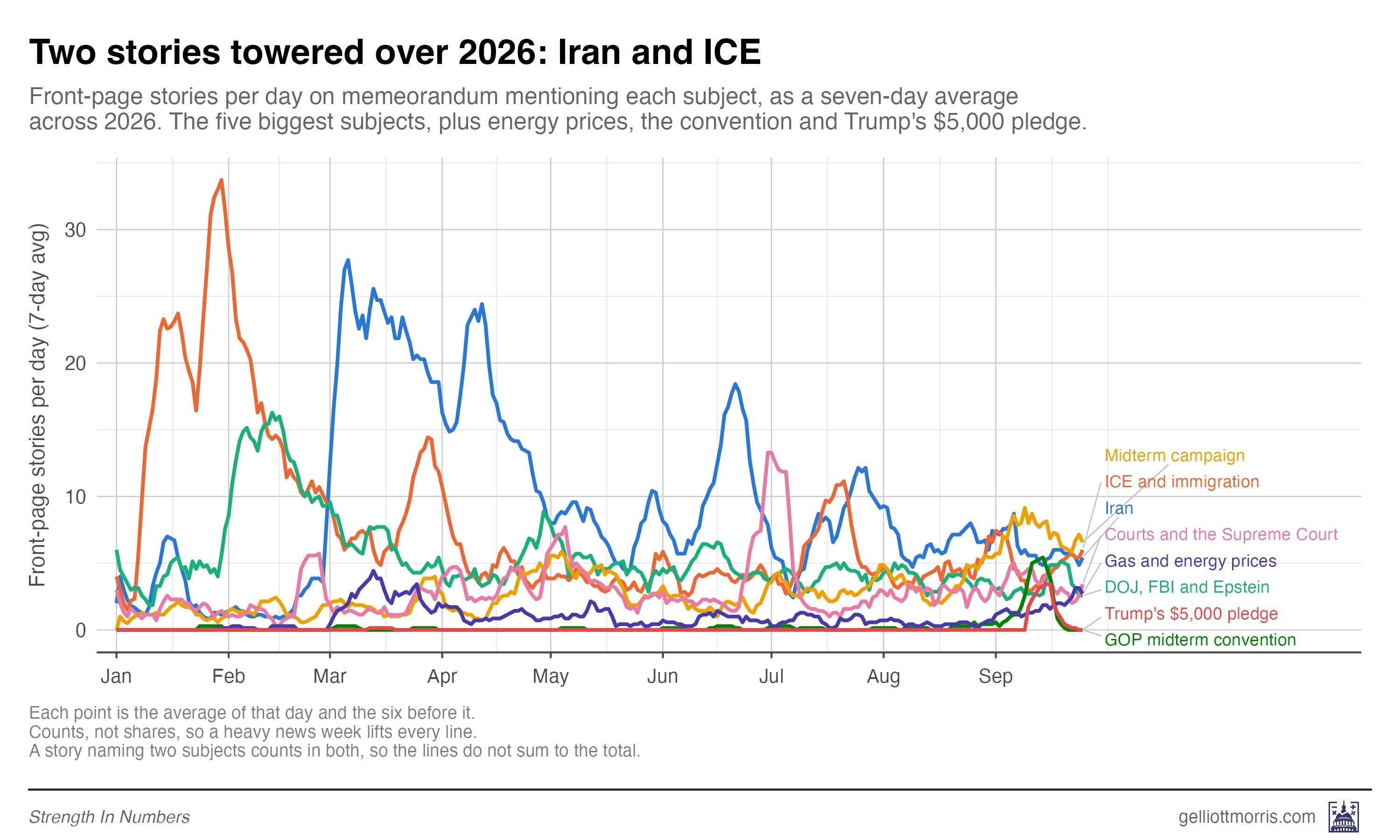
To put some numbers behind this: With 2,481 front-page stories and 9.9% of everything the political press linked to in 2026, Iran is the story of the year. ICE and immigration are second at 2,113 stories and 8.5%. The Justice Department, the FBI, and Epstein come third at 1,447. The midterm campaign itself managed 805, barely ahead of Supreme Court coverage at 791.
The midterm convention is the green line along the bottom. While there is a visible spike on Sep 9-10, it never led the news with just sixty-five stories linked at memeorandum.com, 16th of the 18 subjects I tracked in 2026. If you count Trump’s $5,000 promise as convention news, you get 91 total stories and 0.4% of the 2026 news agenda.
But we shouldn’t expect the convention to overshadow events that happened earlier in the year. A more useful statistic is the percent of all stories that are devoted to each topic, on the day coverage of that topic peaked.
The convention was a minor story even while it happened
The convention’s single best day of coverage was Sept. 10, when it took 11% of the front page in isolation and 23% when you include headlines about Trump’s $5k promise. Here’s how that compares with every other subject’s biggest day of the year:
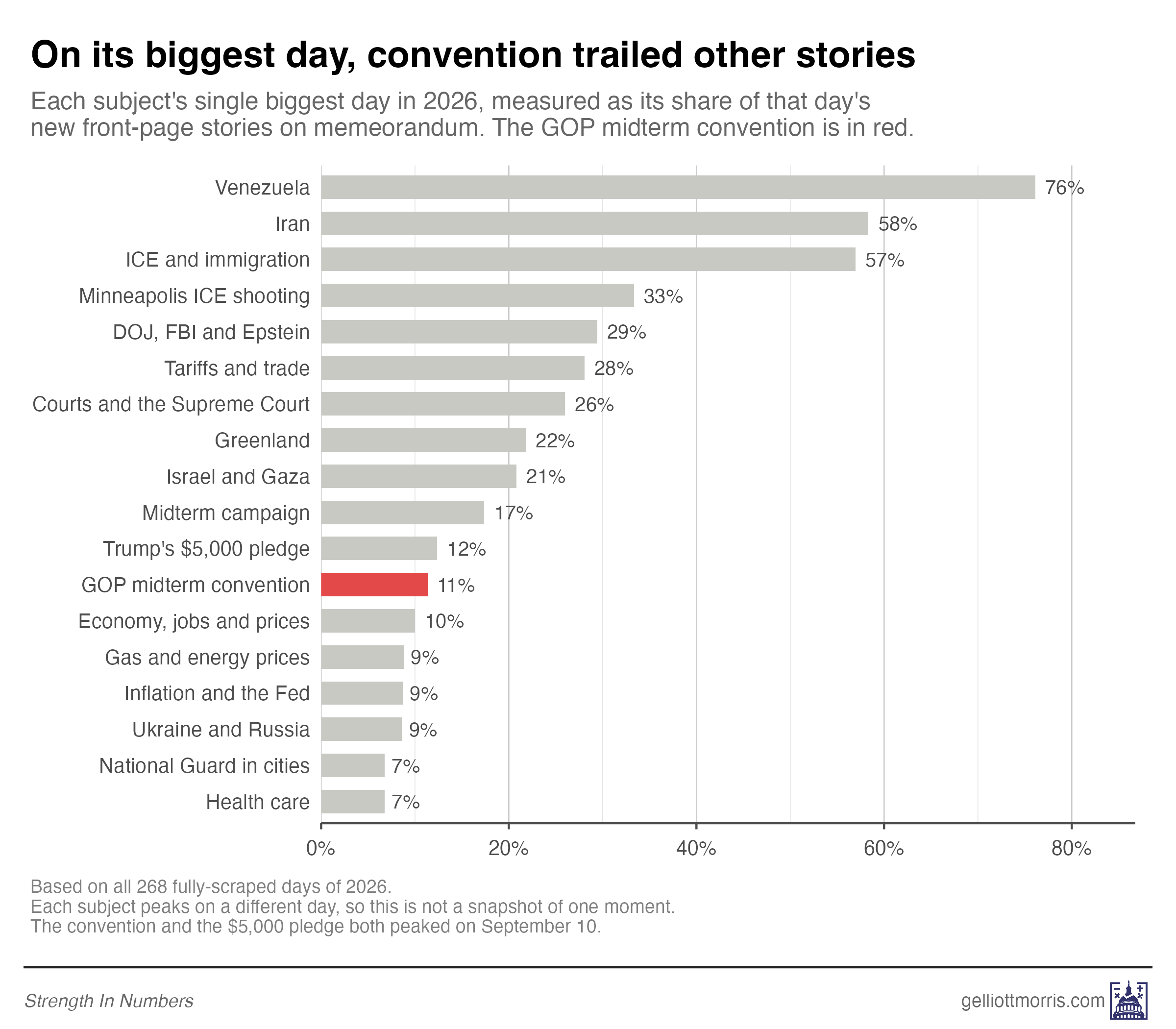
For comparison, the invasion of Venezuela to capture Nicolás Maduro was 76% of the front page on Jan. 3, Iran’s biggest day was 58%, and on the day ICE agents shot and killed Renee Good in Minneapolis, immigration was 57% of all stories that showed up at memeorandum.com. That makes it between the eighth and twelfth most covered story of the year.
Convention coverage usually lasts two weeks. Trumpapalooza faded in six days
Because we have data going back to 2016, we can also compare coverage of the Trumpapalooza “convention” against the presidential nominating conventions in the archive, each aligned on its opening day. Trump’s convention is the thick green line at the bottom of the chart. (I excluded 2020 because of disruptions to the usual convention proceedings due to COVID-19.)
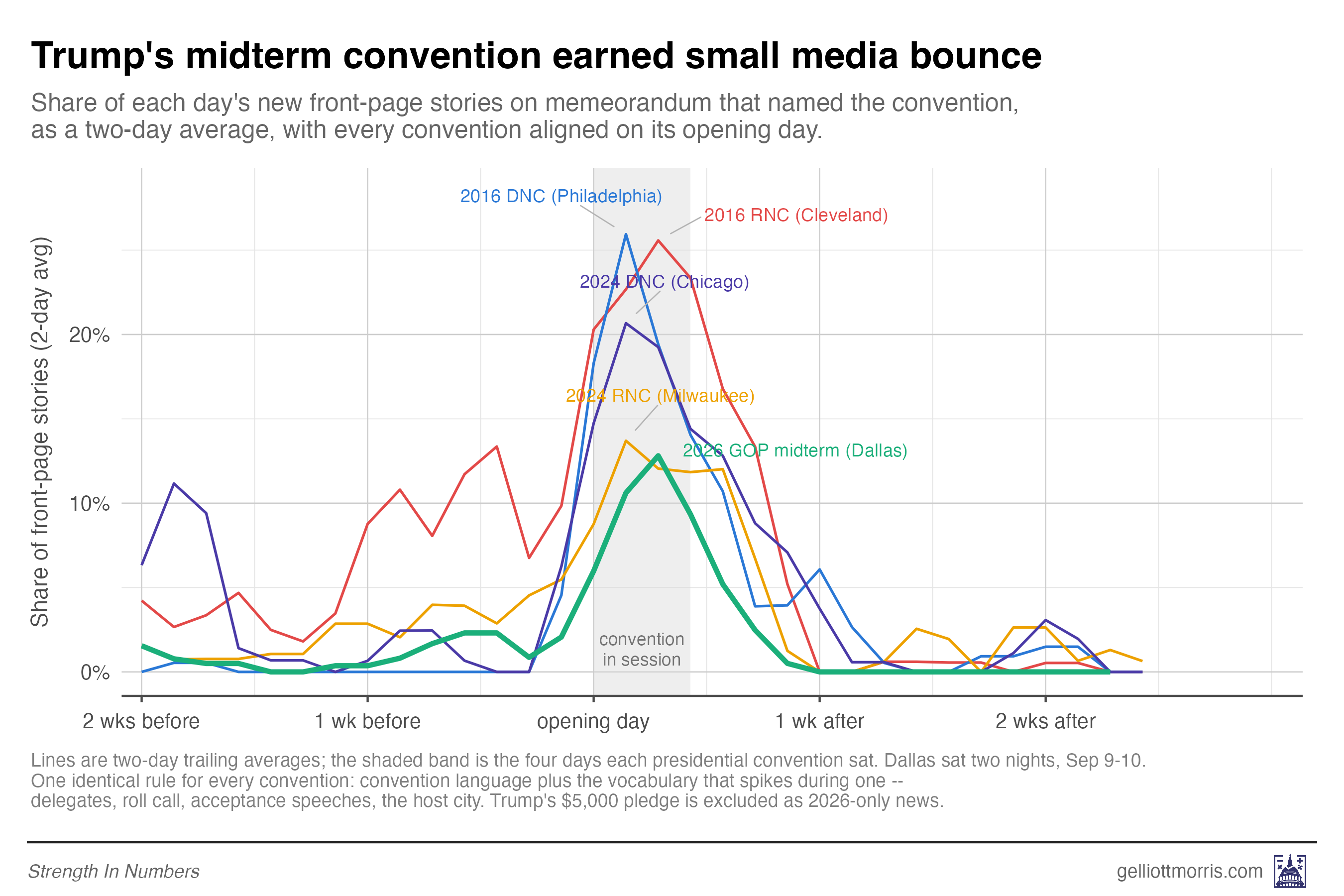
In the two weeks before and after the 2026 midterm convention, coverage of the event made up 1.8% of front-page stories. The previous low was the 2024 Republican convention in Milwaukee, at 3.7%. Philadelphia in 2016 got 3.8%, Chicago in 2024 got 5.0%, and Cleveland in 2016 got 7.0%.
And the chart shows how fast everyone moved on from Trump-fest. The last front-page story about the convention ran on Sept. 14 (”’Trump Dividend’ is the new Trump Steaks”), and from Sept. 15 through Sept. 25, eleven full days, not one convention story hit the front page of memeorandum.com in any five-minute snapshot I archived. (Two stories about the checks did, on Sept. 15 and 17.) Over the same eleven days after their own conventions, the 2016 RNC in Cleveland got 3 stories, 2024 DNC 7, 2024 RNC 8, and 2016 Democratic convention in Philadelphia got 11.
Now there is an obvious objection to this comparison: Nominating conventions have multiple days of real programming and a presidential nominee; we shouldn’t expect a similar scale of coverage from a midterm convention with less news potential. But that’s partly the point: Without potential big news events, the expected earned media bump from the gathering should have been proportional to the expected impact of a normal Trump rally.
And as our September Strength In Numbers/Verasight poll showed, the one big headline that was generated by the convention is dramatically unpopular with voters. 62% of adults say Trump promised his $5k victory dividend mainly to win votes, and 71% say it’s inappropriate for a president to condition payments on his party winning elections (including 53% of Republicans).
This, while the president and his surrogates failed to defang the affordability issue that’s dragging down his party. While the speeches delivered at the convention were obviously geared to shift the national political conversation toward other issues — in his remarks, J.D. Vance spoke at length about transgender sports and “radical left,” and spent 10 minutes addressing a feud with Michigan Democratic Candidate Abdul El-Sayed over a throwaway line about J.D. Vance’s “papaw.”
Stories about affordability have only increased since Trumpapalooza
On the convention’s first night, Trump told the crowd, “Our costs are coming way down.”
Here’s the proportion of all news stories devoted to major topics this year. The convention is the blue bump in September (Trump’s 5k pledge is in orange). The red band on top is the cost of living — including coverage of inflation, the Fed’s actions, prices, groceries, rent, gas and diesel — and it’s the one subject currently growing in coverage:
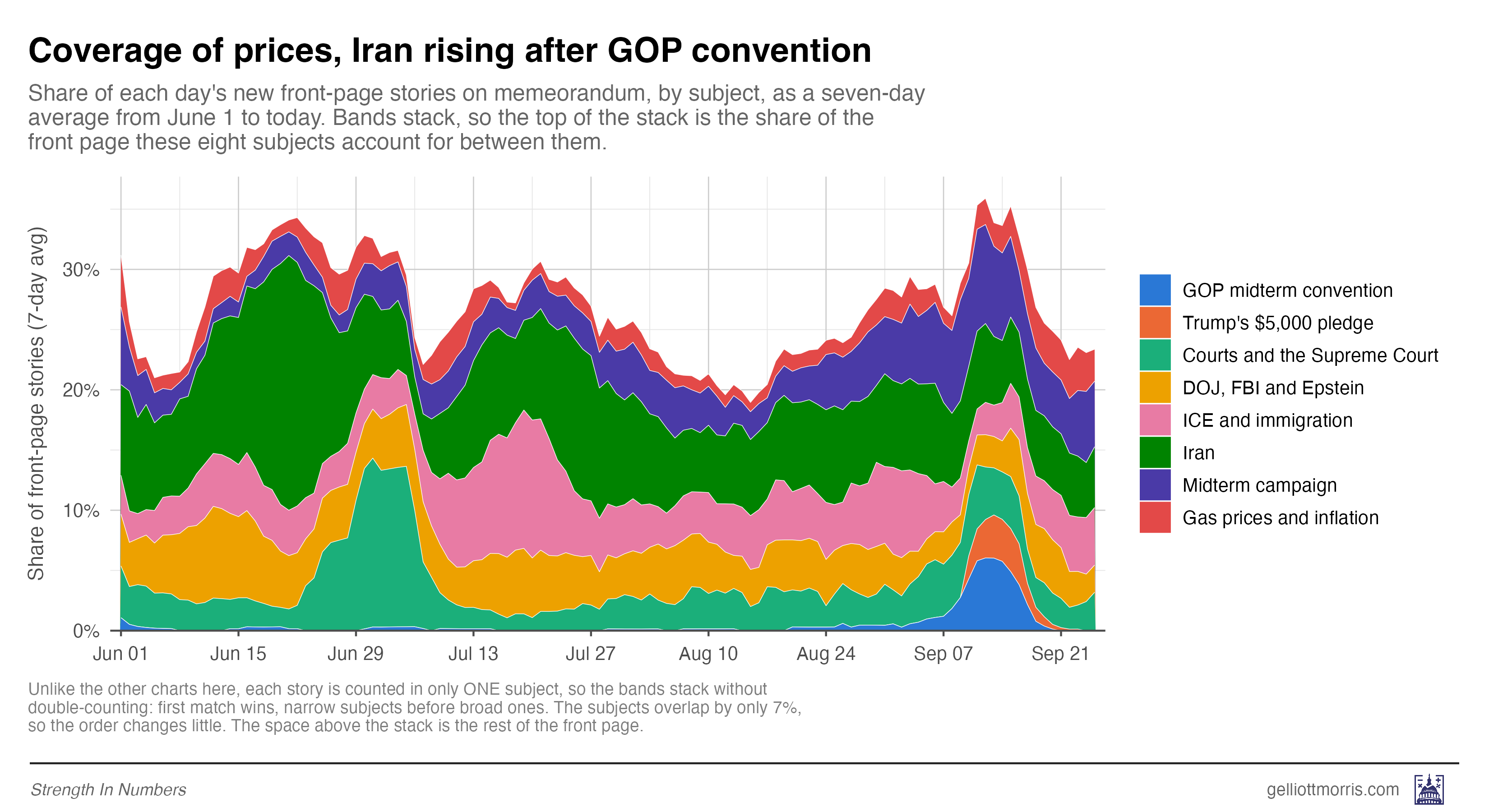
Across June, July and August 2026, cost-of-living headlines accounted for an average of 1.8 stories per day at memeorandum.com. Through Sept. 25 they’re running at 3.4 a day, an 88% jump. September has carried at least one front-page story about prices for 25 of the past 28 days.
Most of that increase in coverage of inflation/prices is about gas/diesel. Energy headlines have more than quadrupled since August, from 0.45 a day to 2.0, the highest since the oil shock in March. This includes headlines like “Diesel jumps above $6 a gallon, adding to inflation pressure.” “A ‘sleeper issue’ in red states this fall: Diesel prices.”
There have been sixteen front-page headlines about diesel on memeorandum.com in five days. Meanwhile, the convention itself and Trump’s $5k bribe haven’t made the front page since Sept. 14.
The Republicans staged a first-ever midterm convention this year in an attempt to activate low-turnout GOP voters ahead of likely defeat this November. I have explained why the strategic logic here was flawed, and shown that the midterms landscape has only moved toward Democrats since the gathering ended.
In this piece, I have shown that the midterm convention also failed to earn media coverage in the way past midterms do. While Trump and other GOP leaders clearly aimed to move the press off the affordability story, coverage of the convention itself and the president’s $5k offering was short-lived — and stories about prices have only circulated more in the two weeks after.
Aside from prices, the notable feature of the other lead stories in 2026 — Iran, ICE, and Epstein — is that they all divide the Republican coalition, Iran in particular. This is why I have said the GOP is effectively being torn apart from two ends, both the middle and the far right.
In the end, this is a good reminder that the midterm rout for the party in the White House is as close to a law of physics as we get in politics. With a president at a 35% approval rating, it was foolish to think that giving him more time in front of the average voter would help his cause. According to our election forecast at FiftyPlusOne.news, the Democrats are almost a sure bet to win back control of the House, and are now favored (at a 7-in-10 chance) to flip the Senate.
If you like the free version of SIN, please consider becoming a paying subscriber to support our work. In exchange for your currency, you will get access to our private community and additional premium analysis at least once weekly. Paying members of this community keep Strength In Numbers running by supporting the time and data collection it takes to do analyses like this one.


Great work. I believe you have the basis here for measuring the effectiveness of truth telling and propaganda on public sentiment/opinion. This can be accomplished using databases such as your headline database, and your public opinion polling in time series.
Sounds like a survey connecting reader responses to journalistic political stimuli -- including the government-sponsored ad you commented on elsewhere needs to be in the offing. BTW, I was so shocked by the ad that I thought it might have been a left-sponsored propaganda piece the first time I saw it.