


This article reports results from the May 2026 Strength In Numbers/Verasight poll (1,520 U.S. adults, online, May 18–19, ±2.7 points). You can read the main release here and our previous poll releases here.
All the writing and data you see at Strength In Numbers is subscriber-funded. If this work is useful to you, upgrade to a paid subscription to keep our independent data journalism project going — and to get the full polling crosstabs, early access to new data products, and my premium Tuesday Deep Dive columns.
When Donald Trump took office in January 2025, he inherited an economy that was the envy of much of the developed world. America had falling inflation, a tight labor market, strong sales and manufacturing growth, and consumer confidence was recovering steadily for the better part of a year. While prices still seemed high compared to their historical trend, this was really one of the only serious dark spots on the economy when Trump took office. The post-COVID economic recovery in the U.S. looked like something of a miracle when compared to peer countries.
Sixteen months later, everything is changed. Trump’s policy of sweeping global tariffs has pushed up the price of imported goods from groceries to gasoline. Mass deportations have thinned the workforce in agriculture, construction, and food service, squeezing supply and lifting costs in exactly the sectors households feel most. The One Big Beautiful Bill, signed last summer, extended unpopular tax cuts that were skewed to the top while cutting a trillion dollars in funding for Medicaid, SNAP, and other federal subsidies, and let ACA’s enhanced premium subsidies expire at the end of 2025. Headline inflation has climbed back to 3.8%, and gasoline is up 50% year-over-year.
Americans have noticed. In our new Strength In Numbers/Verasight poll, 58% of Americans say Trump’s policy decisions have made the economy worse since he took office. Just 21% say he’s made it better. And this anxiety hits close to home, too. A plurality of 47% say their own household finances are worse off since Trump took office.
The story in this poll is not just that Americans dislike Trump’s economy, it’s that they are connecting national economic discontent to their own household bills — and increasingly assigning responsibility to the president now in office. By a margin of 41% to 16%, Americans now blame Trump rather than Joe Biden for the high cost of living.
What policy solutions do Americans favor? The poll points to a fairly clear agenda. Voters overwhelmingly want lower grocery prices, lower rent, lower health insurance premiums, and higher wages. When forced to pick policies rather than outcomes, they gravitate towards tax cuts for middle- and working-class households (35%), higher taxes on high earners and corporations (29%), stricter regulation of corporate price-gouging (23%), and reducing the federal deficit. They also want to feel like somebody listens to them.
But this is also a warning for Democrats. As I argued after the DNC’s 2024 autopsy, the anti-incumbent bias that sank Biden in 2024 — and is now sinking Trump in 2026 — does not disappear once power changes hands. Voters will not reward Democrats for being anti-Trump forever. The party will need an affirmative vision for bringing down the cost of groceries, gas, rent, and health care — and the legislative follow-through to actually deliver it. Without that, they will get kicked out the same way Biden was — and the way Trump is being now.
Trump’s economic ratings are at historic lows
Perhaps the president’s worst numbers are on his handling of the economy, an issue Republicans have dominated for the last 15 years. So let’s start there.
Americans render an overwhelmingly negative verdict on Trump’s stewardship of the economy. By a 58–21 margin, voters say his policy decisions have made the economy worse rather than better since he took office — a net rating of -37, and a deeply negative reading for any president this early in a term. Trump’s straight job approval on the economy is 35%, with 60% disapproving, a net of -25. For context, Bush 43’s overall job approval sank to 25% during the 2008 financial collapse — with the economy his worst-rated issue — and Carter’s overall approval cratered into the high 20s during stagflation. Trump isn’t quite there yet — given polarization, I think he’s unlikely to drop into the 20s, though you never know with this guy — but he’s heading in that direction.
These bad ratings are consistent across questions. Trump’s approval on prices and inflation hit a record low of -47 in May’s Strength In Numbers/Verasight poll. Thirty-nine percent of Americans now name prices as the single most important problem facing the country, the highest share we’ve ever recorded for any issue. And a record 62% include prices in their top three most important problems.
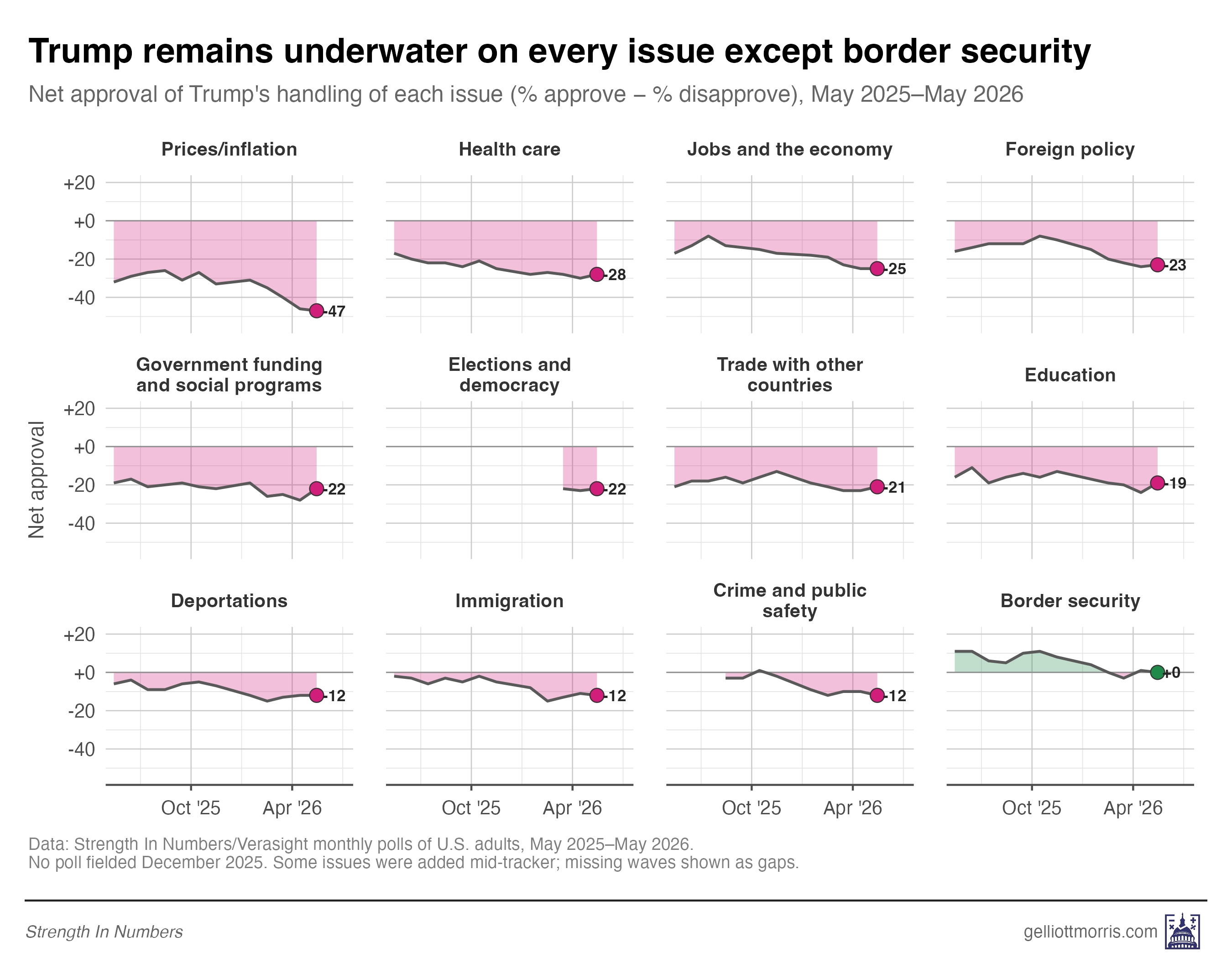
And for what it’s worth, this poll is not an outlier. Quinnipiac (May 15–19) had Trump’s economy approval at 33% — an all-time low for him across both terms (so far). Fox News (May 15–18) had economy disapproval at 71%, also a series high. The New York Times/Siena (May 11–15) had 64% disapproving. CBS/YouGov (May 13–15) found 14% saying Trump’s policies are making them personally better off financially and 57% saying worse — close in shape to our 21/58 split on whether Trump’s policies have helped or hurt the economy, though the questions ask about different scopes. No single poll should be overread, but the pattern across questions — and across pollsters — is unusually consistent here.
We also asked how Americans would grade Trump against their own pre-term expectations. Just 30% of Americans say Trump is doing better on the economy than they expected — but 64% say he’s doing worse, including 45% who say he’s doing “a lot worse” than they expected. Independents say worse by 71% to 19%.
Even among Republicans, 29% — nearly one in three — say Trump is doing worse on the economy than they expected, including 10% who say he is doing “a lot worse.” Pull in independents who lean Republican and the share saying worse climbs to 33%. That is a meaningful crack in his partisan base.
Nearly half of Americans say their personal finances are worse under Trump
It’s not just that Americans feel poorly about “the economy” in the abstract. They also say their own personal financial situation is eroding.
We asked respondents to compare their personal financial situation now to when Trump took office. A 47% plurality say they’re worse off — 24% somewhat worse, 23% much worse. Just 23% say they’re better off. Another 28% say things are about the same.
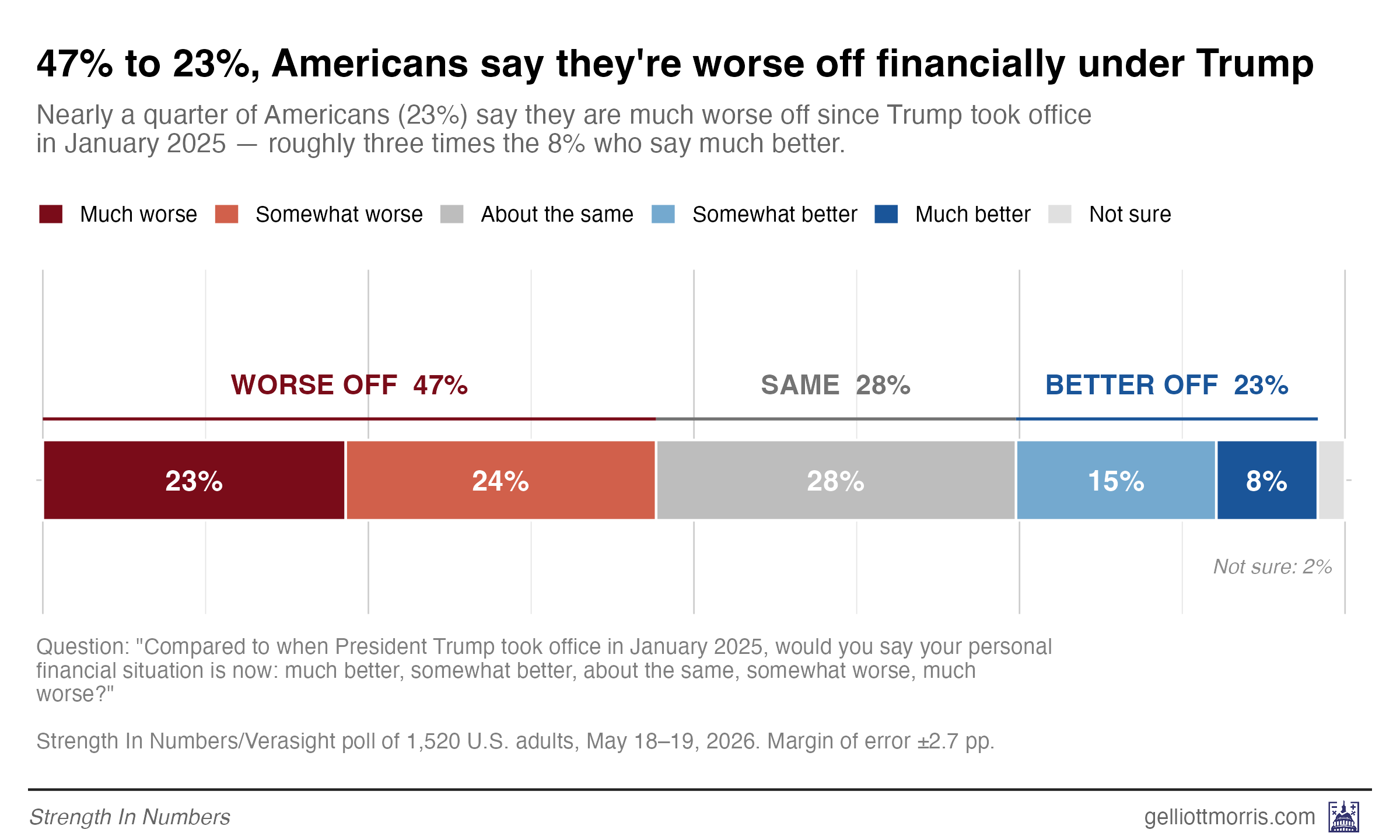
The intensity gap is worth noting. Nearly a quarter of all Americans (23%) say they are much worse off financially since Trump took office — roughly three times the share who say they are much better off (8%). The share who say they are much worse off is the same as the share who say they are somewhat or much better.
61% of Americans are worried about their household finances
When we ask Americans how worried they are about their household’s financial situation, 61% say they are worried — 24% very worried, 37% somewhat worried.
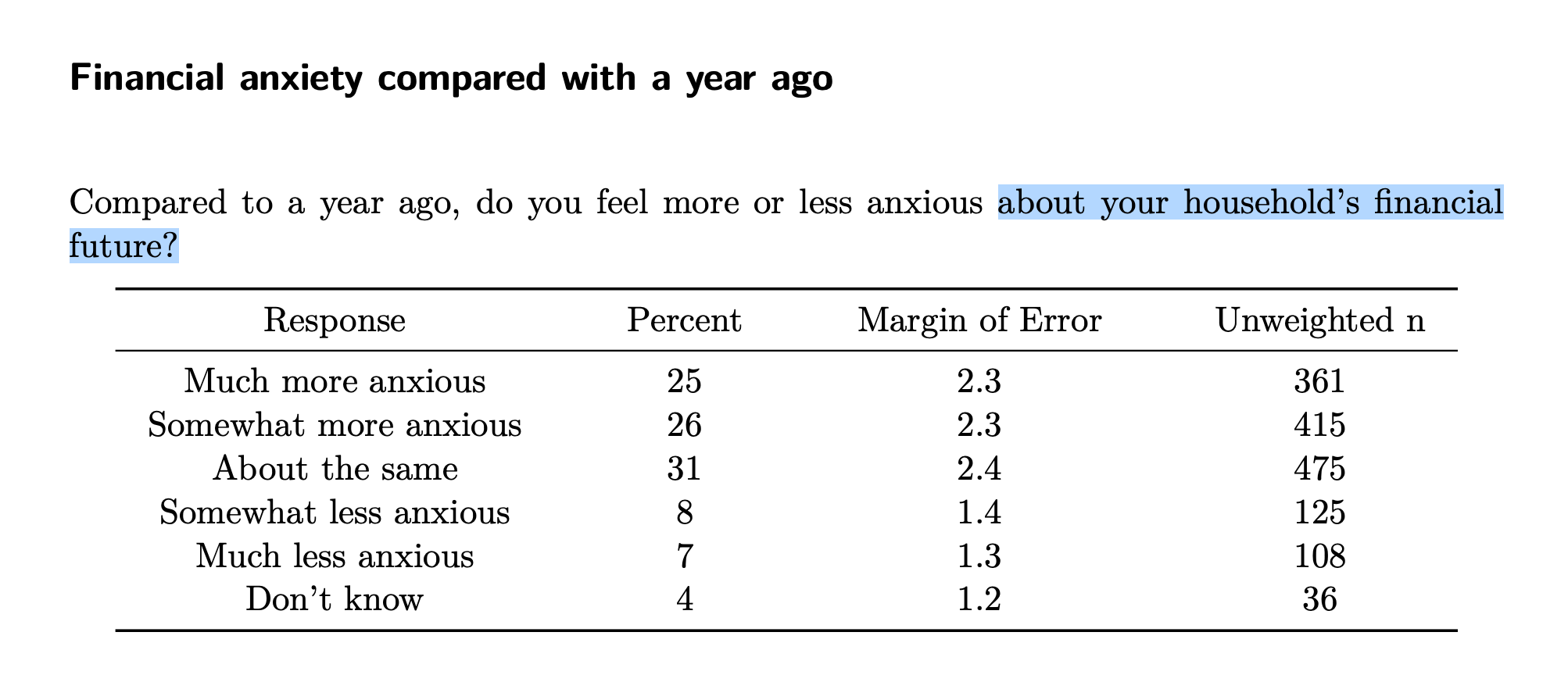
And the worry is intensifying. 51% of Americans say they are more financially anxious now than they were a year ago, including 25% who are “much more anxious.” Just 15% say they are less anxious.
One common talking point about the economy and the “vibecession” today is that Americans are only worried about the economy in abstract, not their own conditions, which they rate as doing well. This data cuts squarely against that narrative. A majority of Americans say they are somewhat or much more anxious about their own household’s financial future than they were a year ago:
The anxiety is producing visible belt-tightening. More than two-thirds of Americans (69%) say they’ve decided not to make a purchase in the past month because of the cost — 33% “very often” and 36% “somewhat often.”
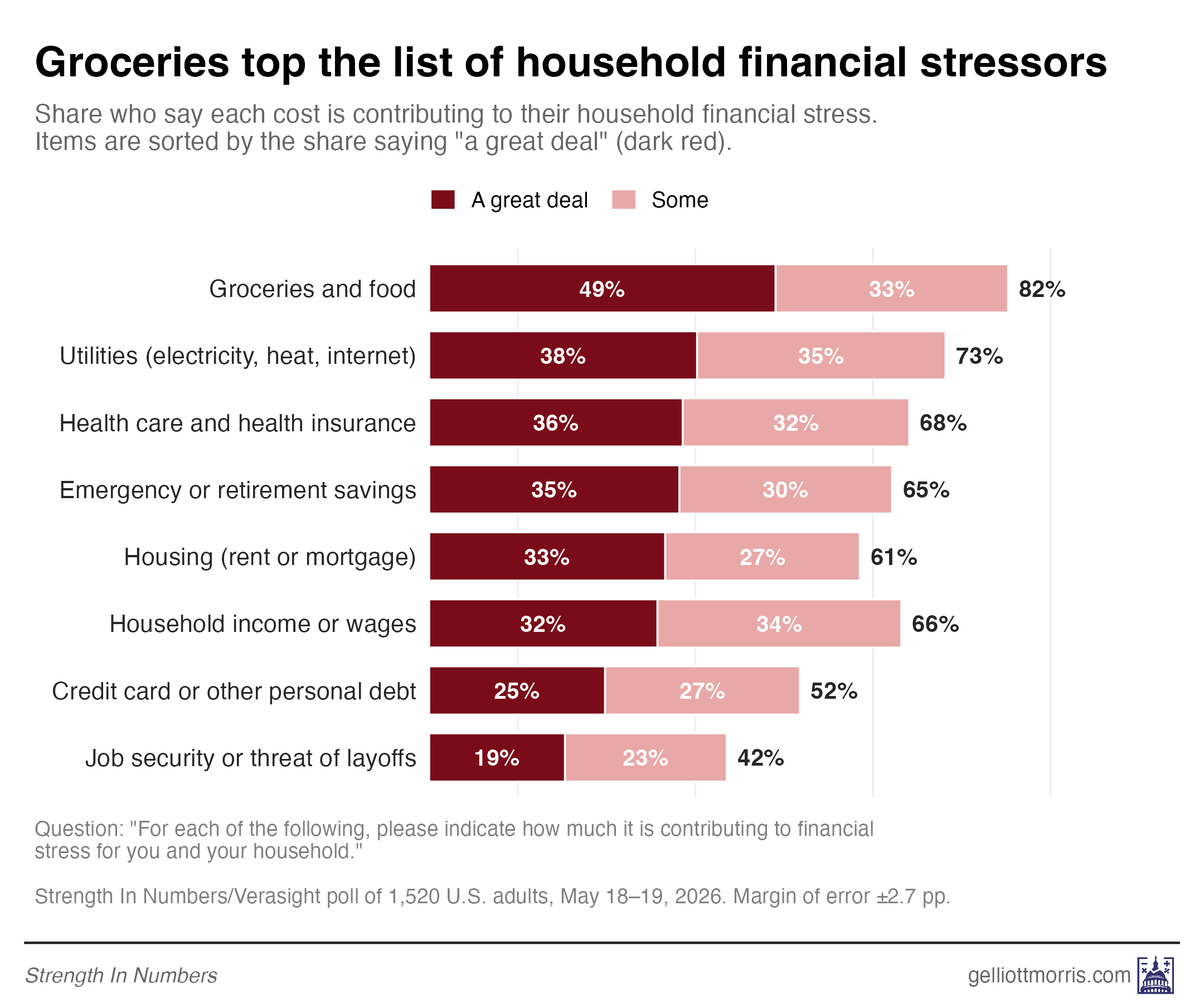
When we asked respondents to rate how much specific household expenses were contributing to their financial stress, the answers track the news exactly. More than any other category, Americans are upset about groceries, utilities, health care, and housing.
Some things that stick out:
Groceries and food: 49% say groceries are contributing “a great deal” to their household financial stress; another 33% say “some” — meaning 82% of Americans are stressed about food prices in some way.
Utilities: 38% great deal, 35% some (73% combined).
Health care and health insurance: 36% great deal, 32% some (68% combined).
Emergency or retirement savings: 35% great deal, 30% some (65% combined).
Housing: 33% great deal, 27% some (60% combined).
We also asked respondents, in their own words, what their single biggest economic worry was right now. I have selected a few examples from across the aisle to embed here, and listed more at the bottom of this article:
“Inflation continuing to climb. Our grocery bills have DOUBLED in the past year. There are things we can do without but food is not one of them!”
— Independent, 45–64“Inflation and cost of living far outpacing my wage.”
— Republican, 45–64, 2024 Trump voter“My electric service increased over 300%.”
— Republican, 65+, 2024 Trump voter
Two of the three above are from Trump’s own 2024 voters.
I coded all 1,273 substantive responses (84% of the sample) by topic. The chart below shows the breakdown.
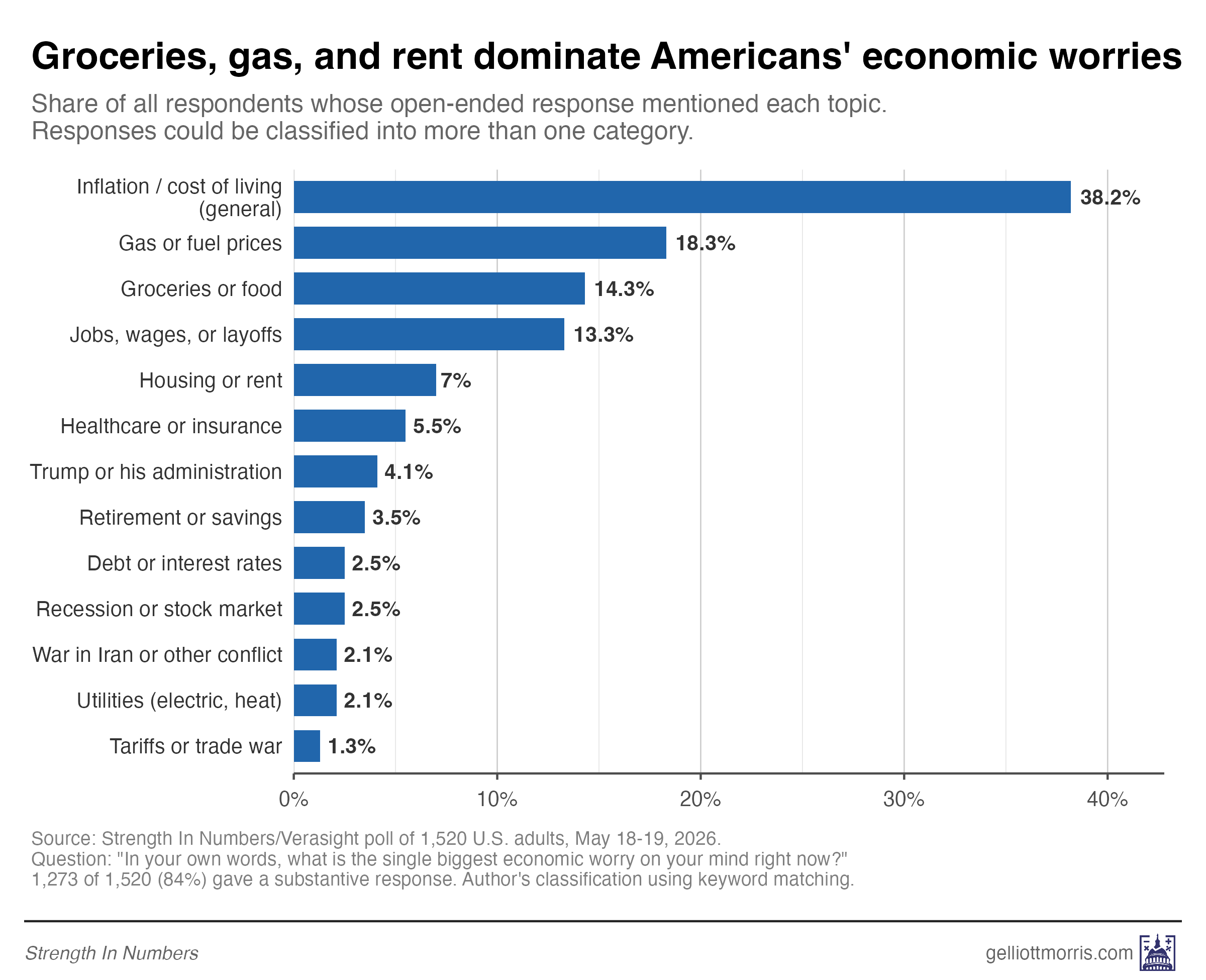
38% of all respondents mentioned inflation, the cost of living, or some general version of “everything is too expensive.” Curiously, that lines up almost perfectly with the share of adults in this survey who say inflation is the country’s number one issue.
When they were more specific about their worries, 18% named gas or fuel prices, 14% named groceries or food, 7% named housing or rent, 13% mentioned jobs, wages, or layoffs, and 6% mentioned healthcare or insurance. Roughly four in ten respondents (36%) named at least one specific household bill by name.
Beyond that core, 4% named Trump or his administration directly, 2% mentioned the war in Iran (almost all tying it to gas prices), and 1% mentioned tariffs specifically. Trump did not need to be named for blame to attach to him — but a non-trivial slice of Americans is putting his name in their own answer, unprompted.
Americans blame Trump for the cost-of-living crisis. They no longer blame Biden.
41% of Americans say President Trump and his administration are most responsible for the cost-of-living problems people face today, more than any other option. That’s more than two-and-a-half times the share who blame Joe Biden and the previous administration (16%). In addition, 11% blame large corporations and CEOs. 8% blame congressional Democrats, 7% say “no one in particular — it’s just the economy,” and 4% blame congressional Republicans. (There are probably many Americans who would blame multiple actors here, but we forced them to pick just one.)
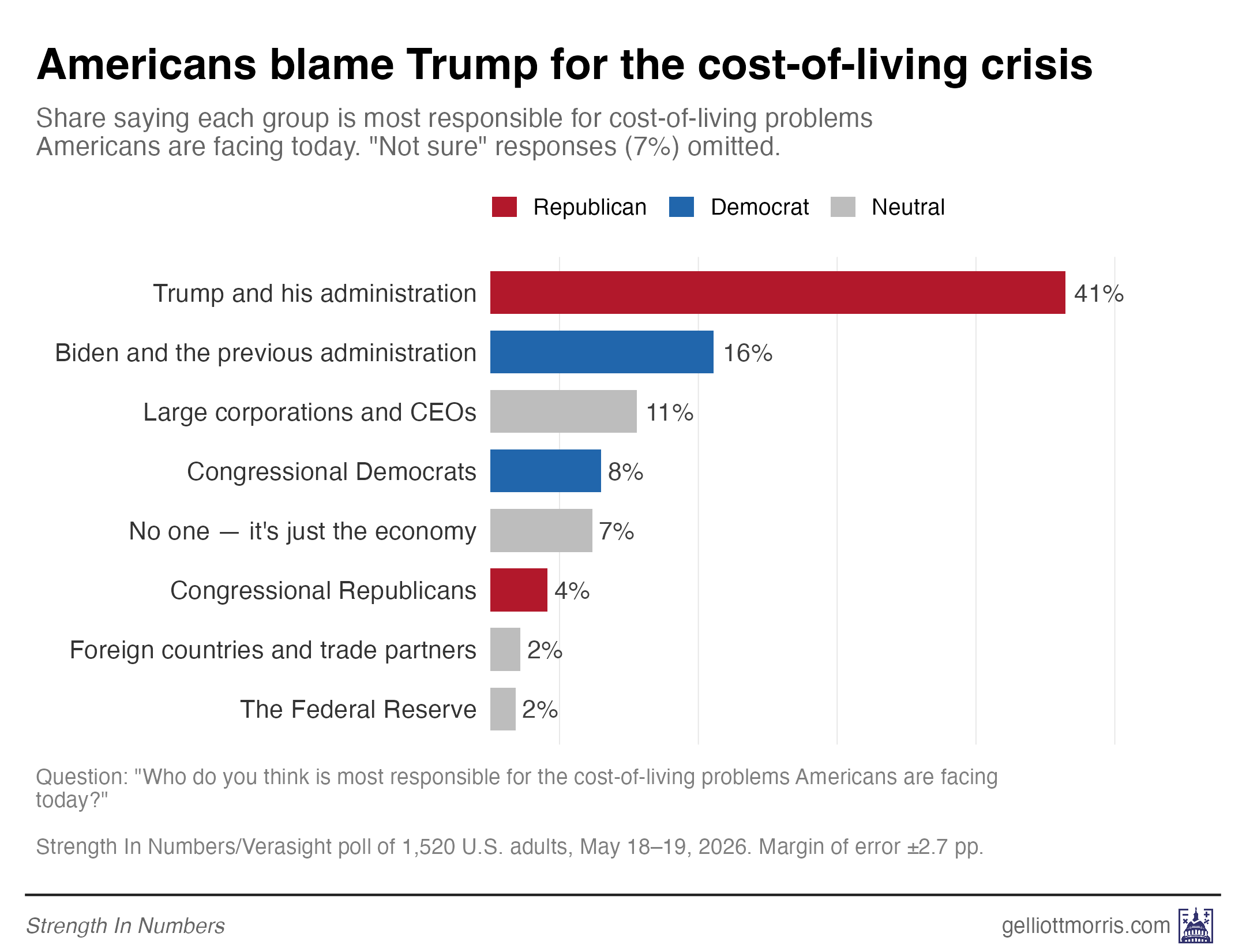
This is one of the biggest political shifts in our poll. For the first three months of Trump’s second term, Americans were still willing to wait and see — in CBS/YouGov’s March 2025 poll, voters still gave Biden slightly more blame than Trump for inflation. By April, the script had flipped: a CBS/YouGov poll that month found 54% saying Trump’s policies were most responsible for the state of the economy versus 21% for Biden’s. By October, the Economist/YouGov poll had it at 57% Trump to 24% Biden. In 2026, the public has settled.
The next question is what Americans want done about this.
What voters actually want
When we asked what outcomes would most help reduce people’s financial anxiety, the runaway winner was simple: lower grocery prices. 64% of Americans said cheaper groceries would help “a lot,” 20% said “some” — a combined 84%. The next-highest item was a raise or higher wages (47% “a lot”), followed by lower rent or housing costs (47%), lower health insurance premiums (44%), and a federal tax cut (42%).
When we asked about outcomes, voters mostly said they wanted relief on household bills. When we asked about policy, they gravitated toward redistribution and corporate accountability.
We asked respondents which two policies below would most reduce their financial anxiety. The top response was a tax cut for middle- and working-class households (35%). The second was raising taxes on high earners and corporations to fund more spending (29%). Stricter regulation of corporations and price-gouging (23%) came in third, ahead of reducing federal spending and the deficit (20%), a higher federal minimum wage (16%), and federal investment in affordable housing (14%).
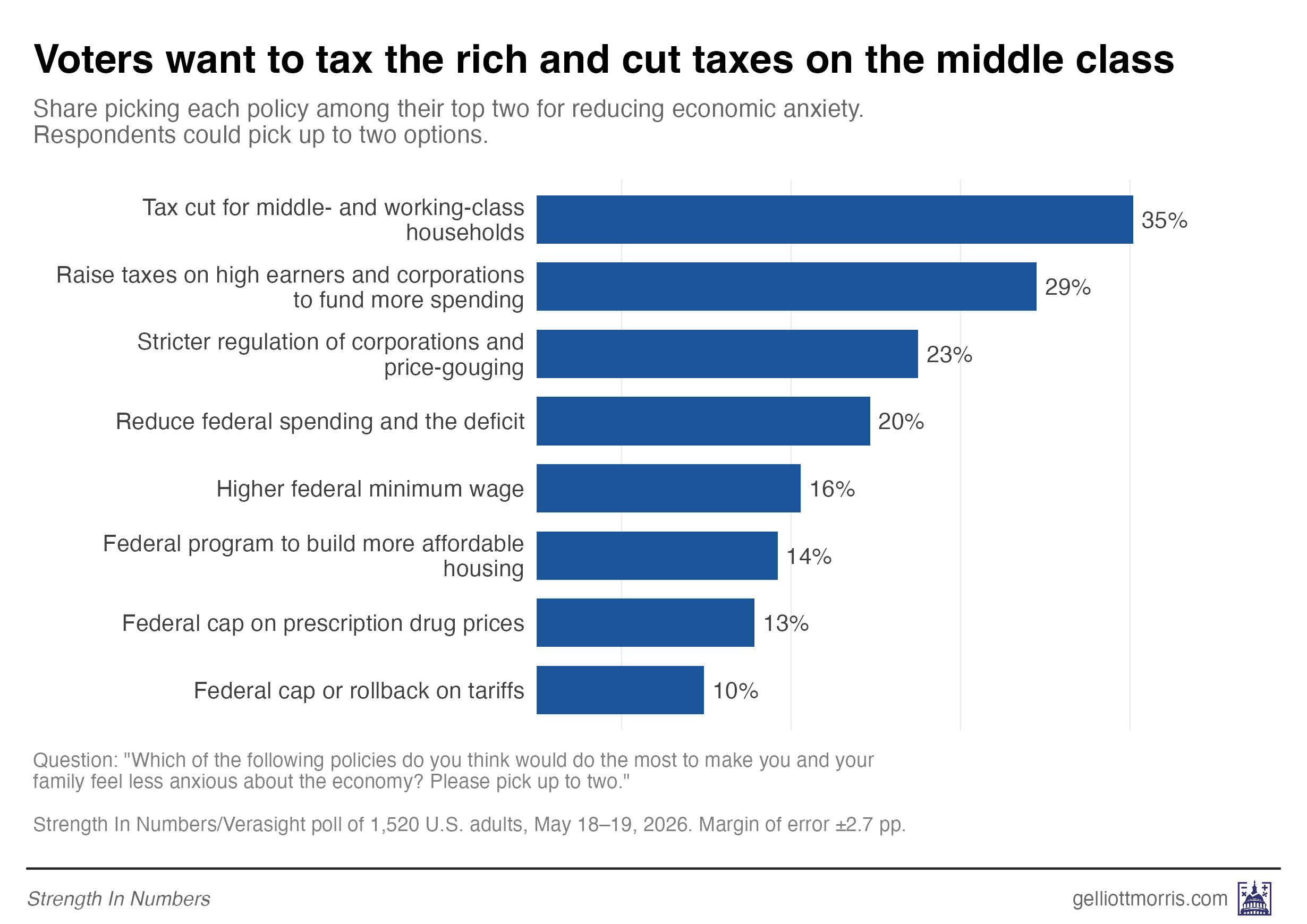
Notably, that is roughly the inverse of what Republicans passed in the One Big Beautiful Bill. The Congressional Budget Office estimated the bill would increase wealth at the top of the income spectrum and decrease it at the bottom: the top 10% of earners gain 2.7% in after-tax income by 2034, while the bottom 10% lose 3.1%. CBO also projects 10.9 million more Americans uwill be ninsured by the end of the decade compared with current law.
If party elites are trying to find out what policies poll well with average Americans — and thus may ease anti-incumbent bias when they are in power — this list is a good starting point.
Democrats are also winning the “cares about people like you” question
For decades, the question “Which party do you think cares more about people like you?” has been one of the most predictive in American politics. In our May poll, 38% of Americans say the Democratic Party cares more about people like them, compared to just 27% (D+11) who say Republicans. Five percent say both equally, and 23% say neither. That is an indictment, on some level, of both parties — but especially the GOP.
Not coincidentally, the Democratic lead on the House midterm vote in our poll is D+10 among adults.
The Democratic opening — and the Democratic trap
(Now, taking off my pollster hat and putting on my analyst/forecaster hat for a section...)
As I wrote last Friday, Democrats need to have a well-researched and authentic economic plan to save themselves from the political pendulum next cycle:
This, of course, will be hard; defying (midterm political) gravity always is. It requires governing the way Roosevelt and Johnson governed, with the assumption that bold action creates its own political coalition. And it also requires you to look back on your failures with a holistic view of what causes certain outcomes.
I have not yet seen anything close to this from the party, from the think tanks, or from the leading 2028 contenders. There are gestures toward the “abundance” agenda, populism, and “radical centrism,” but these mostly read like positioning exercises, not serious agendas for people who are really hurting. The 2024 autopsy was a chance to start that conversation by being honest about why Harris lost. It failed to do that.
This matters because the fundamentals giveth and the fundamentals taketh away. A Democratic win in 2028 built on Trump backlash, without a generational economic vision behind it, is a Democratic loss in 2032 waiting to happen. The only durable answer to anti-incumbent sentiment is to actually earn re-election. The party has roughly two and a half years to decide whether it wants to think that big — and that creatively.
One thing to do is to emphasize policies that solve these anxieties. Voters want cheaper groceries, higher wages, lower rent, and lower health insurance premiums. They want middle- and working-class tax cuts. They want corporations and high earners to pay more. They want stricter regulation of corporate price-gouging. And they want, above all else, to feel like the American dream is working for them.
Crucially, the policy polled here is nothing radical or hard to defend to swing voters. One message that will work well in 2028 is “Trump promised lower prices. Instead, groceries, gas, rent, and health care are squeezing families while Republicans cut taxes for the wealthy and cut health care for everyone else. We need to decrease costs for the average household, restore federal health care funding, and pass a new federal minimum wage hike so everyone is paid a living wage.”
But the overall point is not about the policy specifics, but about the tenor and focus of the party. If Democrats win the House next November — or the White House in 2028 — they will inherit the same angry electorate that just kicked out the other party. Being not-Trump won’t be enough. Party actors need to put some real energy into developing a believable, affirmative cost-of-living agenda, and the legislative follow-through to deliver it, or they will be the next ones blamed.
(Putting my pollster hat back on.)
The political bottom line
Donald Trump came into office promising to bring prices down. Americans believe he’s done the opposite. Their personal finances have gotten worse on his watch. They are anxious about groceries, utilities, housing, health care, and savings. They are forgoing purchases because of cost. They blame Trump and his administration directly, and they support a broad left-leaning policy agenda — middle-class tax cuts, higher taxes on the rich, stricter corporate regulation — that is essentially the opposite of what Republicans have pursued over the last year.
Republicans went into 2025 betting that the public would forgive any short-term economic pain so long as Trump delivered on immigration, tariffs, and his other signature priorities. They were wrong. There are still several months until the 2026 midterms, and the political environment could change — the economic downturn could ease and prices could fall. But as we saw with Biden, once the public has decided who’s responsible for an economic crisis, it tends not to change its mind.
The May Strength In Numbers/Verasight poll surveyed 1,520 U.S. adults online between May 18 and May 19, 2026. The margin of error for the full sample is ±2.7 percentage points. Full toplines, methodology, and crosstabs are available at gelliottmorris.com/poll.
If you made it this far: Strength In Numbers is subscriber-supported. If this work is useful to you, upgrade to a paid subscription to keep our independent polling project going — and to get the full crosstabs and Tuesday Deep Dives.
Related Articles


Appendix: What Americans said in their own words
We asked all 1,520 respondents: “In your own words, what is the single biggest economic worry on your mind right now? Please be as specific as you can.” Below is a selection of representative responses, grouped by topic mentioned.
Groceries and the cost of everything
“Cost of living (rent and groceries) are increasing at staggering rates and wages can’t keep up with it.”
— Democrat, 30–44“Grocery prices have gone through the roof here in South Florida! I am extremely worried at the huge increase in basics such as meat!”
— Democrat, 65+
Gas and utilities
“Gas and grocery prices are absolutely INSANE.”
— Independent, 45–64“Energy expenses (LP gas, electric, fuel: gas & diesel).”
— Republican, 65+
Housing and rent
“Right now I am worried about housing, rent is already high and I’m having issues keeping up — not sure what I will do when it goes up more.”
— Republican, 30–44
Healthcare
“Health care — I can’t afford the health care that I need and I’m dumping my funds into insurance that doesn’t cover enough of my costs.”
— Independent, 30–44
Wages and jobs
“I graduated college a year ago and I’m still unemployed.”
— Democrat, 18–29“I am worried that my job will end and I will become homeless.”
— Democrat, 45–64
Responses from 2024 Trump voters
A reminder that economic anxiety is not confined to Trump’s opponents:
“Inflation and cost of living far outpacing my wage.”
— Republican, 45–64, Male, Trump 2024“My electric service increased over 300%.”
— Republican, 65+, Male, Trump 2024“Rising costs of living, especially housing and healthcare, making it harder to save or plan for the future.”
— Republican, 18–29, Male, Trump 2024“My health care going up and my raise not even covering it.”
— Republican, 30–44, Male, Trump 2024“Life savings gone; living on Social Security alone.”
— Republican, 65+, Female, Trump 2024“Layoffs imminent as executives believe they can replace folks with AI.”
— Republican, 30–44, Male, Trump 2024
How do you factor in, or rather, do you factor in the fact that for the first time in over 50 years, Texas Democrats have a candidate in every every state house, state senate, congressional, statewide judicial, and SBOE race? Would that suggest higher D turnout than usual because this year, D's will turnout to vote, even in very red areas, because they have a candidate to vote for? Or is this all factored into the analysis?
https://www.texasdemocrats.org/media/texas-democrats-fill-every-seat-on-the-2026-ballot
Absolutely spectacular analysis! I want to send this to every Democratic Representative like Martin Luther nailed his 95 Theses to the church door.