On this week’s Deep Dive episode of the Strength In Numbers podcast, Elliott sits down with Ben Wikler, former chair of the Democratic Party of Wisconsin, 2025 candidate for DNC chair, and author of the new book This Is the Plan: How to End America’s Meltdown and Save Democracy. We have a wide-ranging conversation that includes such topics as: why no message would have saved Democrats in 2024, how the party wins back the rural voters it has been bleeding since 2008, and the one-shot window Democrats will have in 2029 to unrig American democracy.
Here are the big takeaways:
Wisconsin is the proof of concept for unrigging a broken system. Wikler’s home state was, until recently, a “democracy desert.” In 2018, Democrats won every statewide office and 54% of the state assembly vote — and got 36% of assembly seats, flipping exactly one. Years of organizing later, the state has a Democratic governor, a pro-democracy state supreme court, and new maps under which the party that wins a majority of votes can actually win a majority of seats. As Wikler puts it, that’s how democracy is supposed to work.
No message would have saved Democrats in 2024 — and the loss was still agonizingly close. We talk about the difference between “micro” and “macro” theories of elections. When it comes to 2024, the macro: voters in every developed democracy were furious about high prices in 2024, and every governing party lost vote share — in fact, on average, slightly more than Democrats did. A shift of roughly 115,000 votes across Wisconsin, Michigan, and Pennsylvania — about one-tenth of 1% of ballots cast — would have made Kamala Harris president. The voters who moved were mostly passive news consumers reacting to their own cost of living, not to either campaign’s messaging. Wikler’s advice for Democrats tempted by a single-cause postmortem: don’t lose your soul. Go out into the world and find those voters and talk to them.
Ben says the party’s brand is set by the fights it takes on. Wikler says most Americans get their news about Democrats from Republicans. One candidate quietly moderating on a hot-button issue does approximately nothing to fix its brand problem as an out-of-touch coastal machine. But big public fights present an opportunity. When Republicans tried to repeal the Affordable Care Act in 2017, every elected Democrat fought back loudly — and in 2018, voters who called health care their top issue broke overwhelmingly Democratic. Wikler puts last year’s shutdown fight over ACA funding and opposition to the gas-price-spiking Iran war in the same category: fights that show, over and over, whose side each party is what really moves the needle.
Democrats need to show up, in person. Democrats have lost about a third of their rural voters since 2008, by Elliott’s math, and thousands of local offices. Wikler blames three forces — the collapse of local news, algorithmic feeds, and the party simply not being present — and only the third is in the party’s power to fix. As WisDems party chair Wikler championed a model whereby the state party gave grants to local volunteer-staffed county “storefronts” where party members could relate to everyday voters, in person. He says 44 of the Biden campaign’s 100 field offices grew out of these storefronts. Elliott shares some ideas for taking that program nationwide.
Democrats will get one shot to unrig the system. Wikler argues if Democrats win power in 2028, they will have a small window to enact key reforms to unrig American democracy and give power back to the numerical majority. He wants to pass the National Popular Vote Interstate Compact, reform the filibuster that currently waves through judges and tax cuts but blocks voting-rights bills and progressive priorities, expand the U.S. House and elect it proportionally from multi-member districts, add D.C. statehood, ban partisan gerrymandering nationwide, and reform a Supreme Court that would otherwise strike down all of the above.
Wikler cites Strength In Numbers/Verasight polling from November 2025 in the book — asked in their own words what their ideal party would fight for, 38% of Americans gave answers that don’t fit the left-right spectrum at all. Wikler says what people want is a party that fights for everyday people and makes their lives better.
Ben’s new book, This Is the Plan: How to End America’s Meltdown and Save Democracy, is out now wherever you get your books.
If you value this work and want to help keep it going, please consider becoming a premium subscriber to Strength In Numbers. Paid subscriptions support this podcast, the newsletter, and the time it takes to do this kind of data-driven analysis of politics and elections. Paying subscribers also gain the ability to send in questions during our live streams, so you can directly shape the conversations we’re having on the podcast.

You can also subscribe to this podcast on your favorite podcast app to listen on your own time. And if you do listen via one of those apps, please drop us a five-star rating and review if you feel we’ve earned it — it really helps people discover the show!
A reminder that paid subscribers to Strength In Numbers get to participate in our live Q&A!
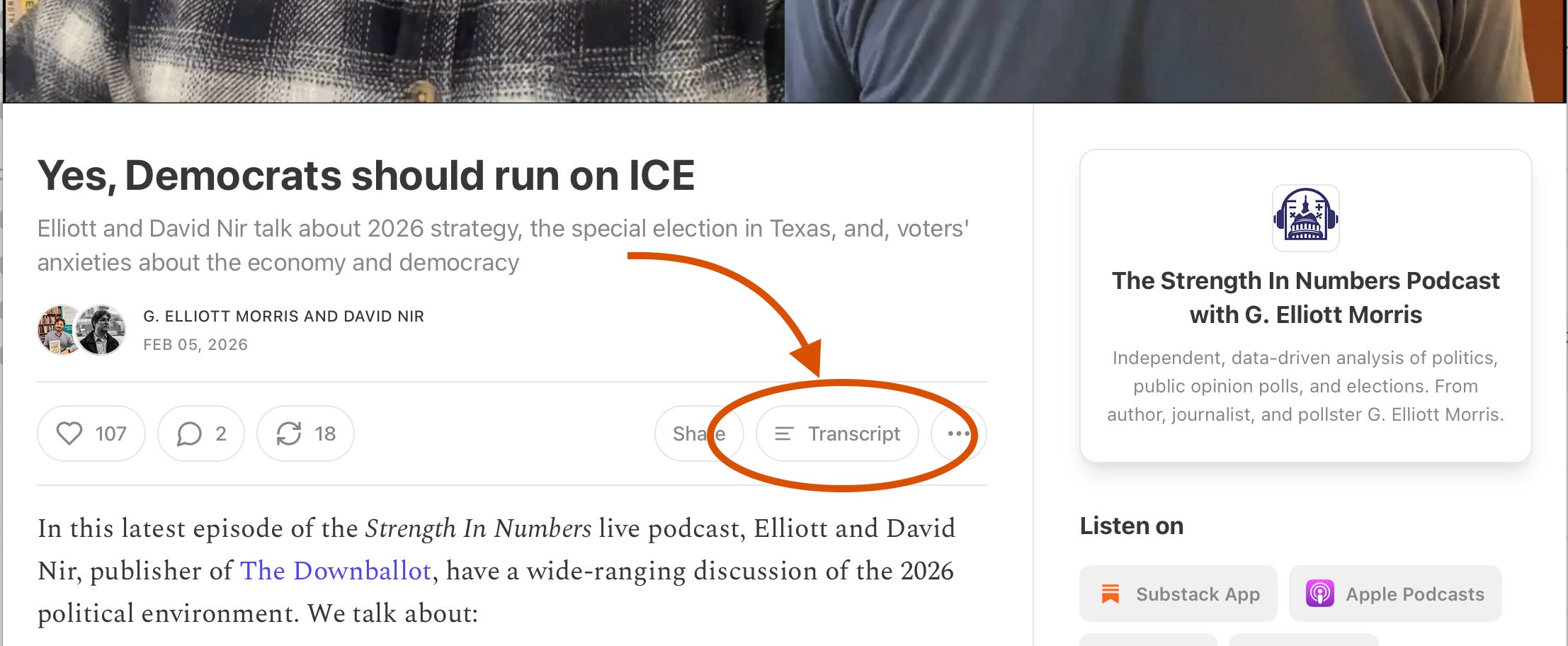
You can also read the transcript of our conversation by clicking the headline of this article to take you to the web version of the podcast, then clicking the button just below the byline that looks either like a piece of paper or is labeled “Transcript,” like so: