


On this week’s Strength In Numbers podcast, Elliott and David dig into Elliott’s newsletter piece arguing the conventional wisdom on polling error might have it backwards this cycle — that the polls could be understating Democratic support, not overstating it, as the polls did in 2020 and 2024. They break down two structural reasons why that could be happening. Then, the podcast closes with a state-by-state tour of the FiftyPlusOne election forecast that’s moved sharply toward Democrats in both chambers.
This video is free to watch, but it was not free to produce. If you value this podcast and want to help keep it going, please consider becoming a premium subscriber to Strength In Numbers. Paid subscriptions keep the show ad-free, fund the newsletter, and ensure we have the time it takes to do original data-driven analysis of politics and elections. Paying subscribers also gain the ability to send in questions during our livestreams, so you can directly shape our conversations on the podcast.
A couple of big takeaways from the conversation:
Polling bias is not predictable from cycle to cycle. In 2022, many election forecasters ended up making worse predictions than they otherwise woudl have by adding extra support for Republicans to “unskew” the polls.
Weighting by recalled 2024 vote could be quietly inflating support for Republicans. Pollsters increasingly weight samples to match the results of the last election, using respondents’ self-reported vote. But people can misremember or change their reported vote — if disaffected Trump voters are the ones now declining to admit they voted for him, the remaining self-identified “Trump voters” skew more MAGA than the actual 2024 coalition. Elliott’s simulations suggest this could be suppressing the Democrats’ generic-ballot margin by up to a point.
Named-candidate polling shows Democrats running ahead of the generic ballot. A YouGov/Economist survey using actual candidate names in each district showed Democrats up 11 points among likely voters, versus 8 points on CBS’s standard generic-ballot question over the same period (also fielded by YouGov) — a gap directionally consistent with but larger than the historical average overperformance for high-quality candidates.
The 50+1 forecast now gives Democrats a 97% chance of winning the House, up sharply from where it stood in prior weeks, and a 65% chance in the Senate, where polls have moved toward Democrats in most competitive states.
Thanks to everyone who joined us for the weekly livestream on Substack. We’ll be back next week!
As a reminder, paid subscribers to Strength In Numbers get to participate in our live Q&A! If you missed our video livestream, you can watch it by clicking play on the web version of this post at gelliottmorris.com.
You can also subscribe to us on your favorite podcast app to listen on your own time. And if you do listen via one of those apps, please drop us a five-star rating and review if you feel we’ve earned it — it really helps people discover the show!

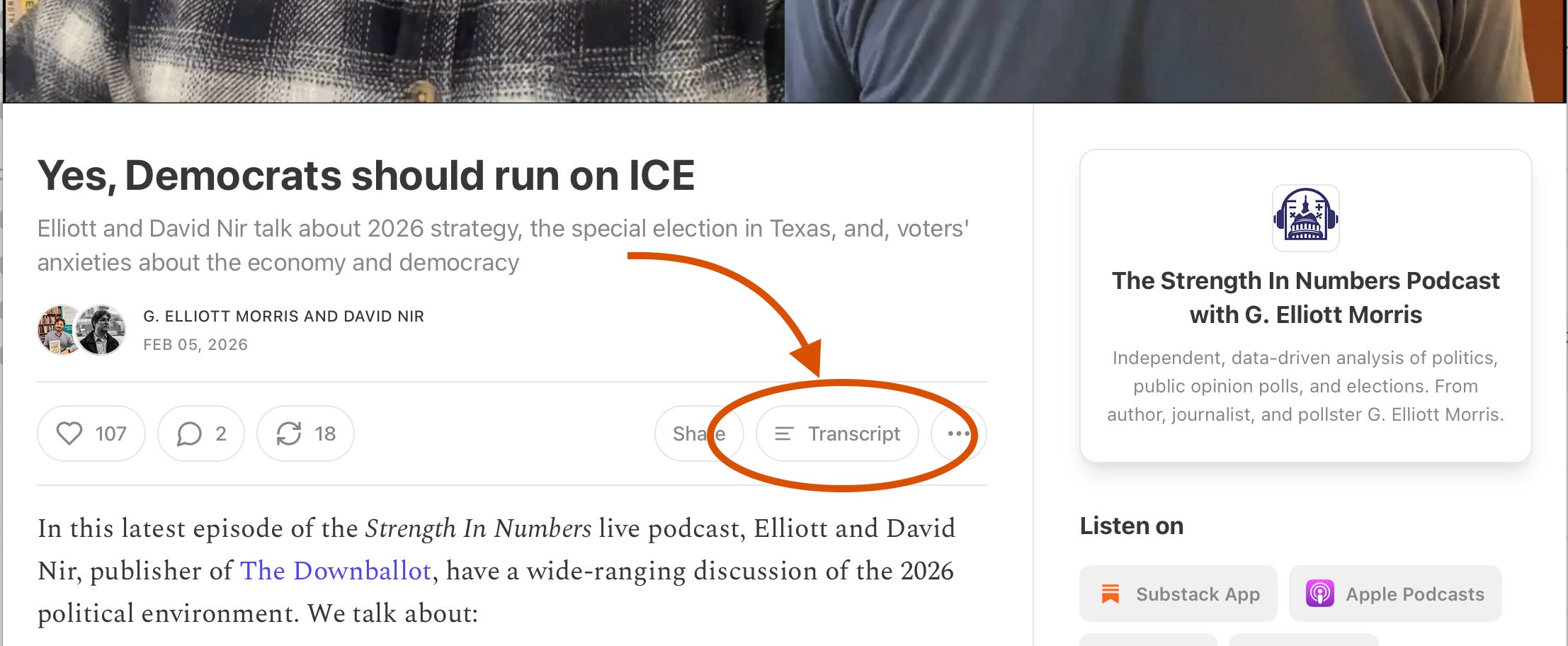
You can read the transcript of our conversation by clicking the headline of this article to take you to the web version of the podcast, then clicking the button just below the byline that looks either like a piece of paper or is labeled “Transcript,” like so:
If you’re a reader of Strength in Numbers and haven’t yet subscribed to David’s newsletter, head to the-downballot.com.
And if you’re coming from David’s site, subscribe here to get the numbers behind the news.


