


This is my weekly Sunday roundup of new political data published over the last seven days. It is free to read, but if you want to support independent data-driven political journalism, become a paying subscriber and get additional data journalism and premium analysis at least once weekly.
Just a couple of links today. My 3-month-old has not been sleeping much, so I haven’t had time to collect as many links as normal. But she did sleep 8 hours straight last night, so I’m feeling punchy in this first section.
As always, thanks for reading this week, and expect more results from our August poll this Tuesday-Wednesday. We were trying to better understand the “Left Tea Party” dynamic in the Democratic Party, so we did a whole battery of questions on what Democrats and Republicans want from party leadership/want the direction of their party to be. That’ll be this week’s Deep Dive.
1. One out of six Trump voters says they wouldn’t vote for him again
In May 2025, I reported on results from my Strength In Numbers/Verasight poll that found Trump would lose around 14% of his 2024 voter base if the election were held again. That alone would have been enough to cost him the election, but we also found a large share of 2024 non-voters said they regretted not voting and would pull the lever for Harris if given the chance:
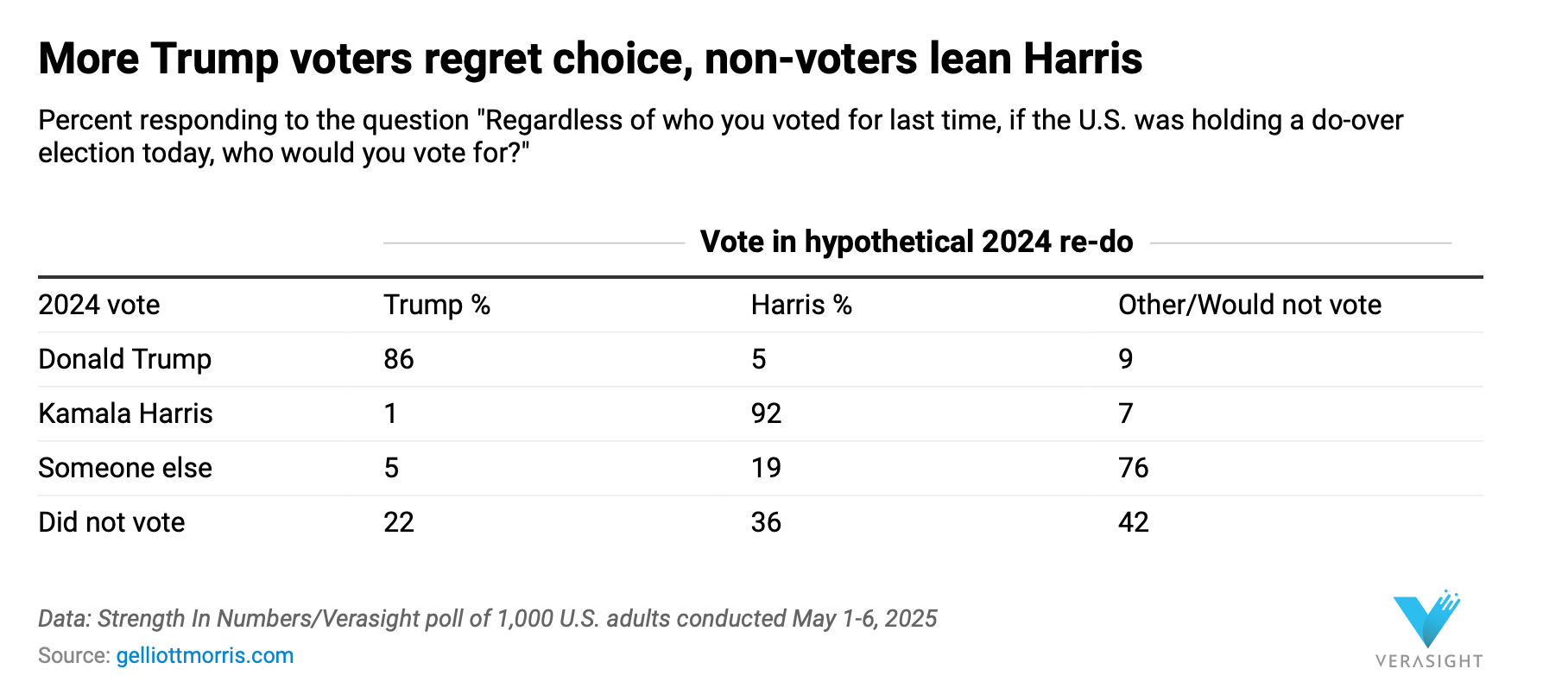
Friend of SIN Michael Podhorzer covered these numbers in a post (again, let me underscore, *in MAY 2025*) titled “the emerging anti-MAGA majority“. He used the vote-transfers above to simulate the results of the election using counts of registered voters:

We were writing these articles in the midst of a wider conversation at the time spurred by CNN’s Harry Enten, who cherry-picked results of a UMass Amherst poll to claim Trump would win a redo election. Enten erred in that (a) the particular UMass poll he cited at the time was an outlier and (b) he only looked at the Trump -> Harris switchers, and not at Trump voters who might pick a third-party option or not vote at all, and he ignored what non-voters would do. Quoting his TV segment here:
“So if there was a repeat, if folks got to be able to redo their vote that they had back in 2024, would the result be any different? I doubt it would be. I doubt it would be or it would still be extremely close. The bottom line is for all this talk of Trump voters regretting their vote, in the numbers, it really just doesn’t show up.”
This was wrong at the time, and is one of the many clips of pundits covering polls early in the second Trump administration that have aged very badly.
Anyway, I was reminded of all of this Trump regret polling this morning when a new UMass Amherst poll came through my inbox on early release late last night. According to the new poll, only about five in six Trump voters say they’d support him in a redo election (so 1/6 defect). The defectors are unequally split between switching to Harris, a third-party candidate, or not voting at all — but the full results are due out on Monday, so I can’t share the full topline yet.
And this is no outlier. As mentioned, the Strength In Numbers/Verasight poll found the same level of defection in May 2025. The UMass results also broadly align with the numbers in a poll my company, Wave Polling and Research, conducted for a client in February 2026 — and also in a new survey we put out today.
Strength In Numbers has been early in detecting backlash to Trump. That’s because we’re open-minded about the data, not because I have special powers or proprietary data.
In the spring of 2025, the conventional view from U.S. political pundits was that Trump had won a real national mandate for political change. Republicans, in the popular telling, had picked up durable new cultural authority along with it, and the Democrats’ only route back to power was to give up significant ground on economic and social policy. This was the height of popularity, for example, of such wrong-headed arguments as “Democrats shouldn’t talk about immigration.”
New York Magazine said the right was on a path to “cultural domination”:

I spent a good chunk of last spring arguing that this dominant view was incorrect. Trump won a small victory in 2024, the numbers showed, and Trump, the man, was consistently more popular than Trumpism, the political project. The individual planks of his immigration agenda polled particularly poorly compared to his topline number on the issue. A lot of powerful people simply did not realize how unpopular Trump was, and they were paying a price for their ignorance. (In the case of many politicians, a political price; CEOs, a literal one.)
But the thing is… this was obvious. None of those articles took a special questionnaire or blockbuster data source to write. You just had to look at the data with an open mind. The polling data I used to write my original “Trump wouldn’t win a redo election” article wasn’t hidden on my hard drive, but out in public crosstabs for anyone to read. Even the UMass results Enten used to argue Trump would have won a do-over in April 2025 in fact contradicted him if he had just read the full poll!
We weren’t writing about anything hidden, or partisan, or really even early. It was just uncomfortable for people to write these takes when the zeitgeist demanded different.
Final note on this subject: A related problem I see all the time still — in the fall of 2026! — is the refusal to view Trump’s victory in 2024 through the lens of anti-incumbent bias or normal retrospective politics. While a lot of opinion columnists want to pretend, for example, that Trump’s win was because of backlash to “woke one” (see here), this is a completely unempirical view. Like the original Trump Regret article from Enten, it is frankly, obviously wrong to anyone willing to look at the data with an open mind.
2. What Strength In Numbers published last week
Last Sunday’s roundup had a refreshed version of the neighborhood-level model of Trump’s job approval, down to your own neighborhood — there’s exactly one demographic group left in the country that’s net-positive on him:

On Wednesday, the August Strength In Numbers/Verasight poll landed, and Trump lost his last positive issue — he’s now net negative on border security, with strong disapproval outnumbering strong approval by nearly 3-to-1:

On Thursday, I talked to economist Rajiv Sethi about prediction markets — whether they beat pollsters, why they blew the papal conclave, and whether they’re going to eat forecasting and journalism:

And on Friday, I opened up 15 months of our own polling to check two things people keep telling me are wrong with surveys this cycle: that respondents are getting more progressive, and that weighting by past vote is loading up on hardcore Trump voters. Neither one shows up in our data:

If you’re a frequent reader of Strength In Numbers, I’m confident you will get a lot of value out of a paid subscription. You’ll get access to all of my Tuesday Deep Dives, monthly polling crosstabs, our private community of election nerds on Discord, and more.
3. Even more numbers!
My colleagues Mary Radcliffe and Cooper Burton wrote at FiftyPlusOne on Thursday that “No, the polling industry is not on the verge of collapse.” Fake polls, new pollsters, and a shift away from live phone surveys, they say, are all nothing new. While recent misfires in primary polls have been large, they have not been atypical.
Stephen Clermont and Lauren Goldstein, two Change Research pollsters, similarly argued last week that measuring opinion so you can move it has always been part of their job as private/campaign pollsters. They say that polling for strategy does not prove that polling is broken.
I don’t do a whole lot of campaign-style polling work personally, so I view this mindset to be significantly different from that of a public pollster, whose job is to measure, not change. Here at Strength In Numbers, we use polling to measure the will of the people and give them a megaphone in Washington. (Kinda my whole philosophy on public opinion and democracy...)
The Economist/YouGov, August 21–24: Democrats up 6 on the generic ballot among registered voters, 46% to 40% — and up 11 among the registered voters who say they’ll definitely turn out in November. Likely voters, data centers, ‘woke,’ and more
Pew’s Andrew Mercer found that there is “no easy fix for bogus respondents in online opt-in polls.” Data from survey marketplaces should be treated with a lot of skepticism. Voter file matching and pre-screening (like Verasight does for SIN, off their panel of both web respondents and people recruited from probability sources) are a must.
Marquette has David Crowley up 49–44 on Tom Tiffany in Wisconsin among likely voters. Crowley is leading Tiffany among likely voters, tied among all registered voters.
Cook moved three House races in Michigan and Florida toward Democrats this week, including two out of Lean Republican and into Toss Up. Three House Race Ratings in Michigan and Florida Shift in Democrats’ Direction
My take is Cook is still significantly behind the curve in the House. I hope to write about this this week.
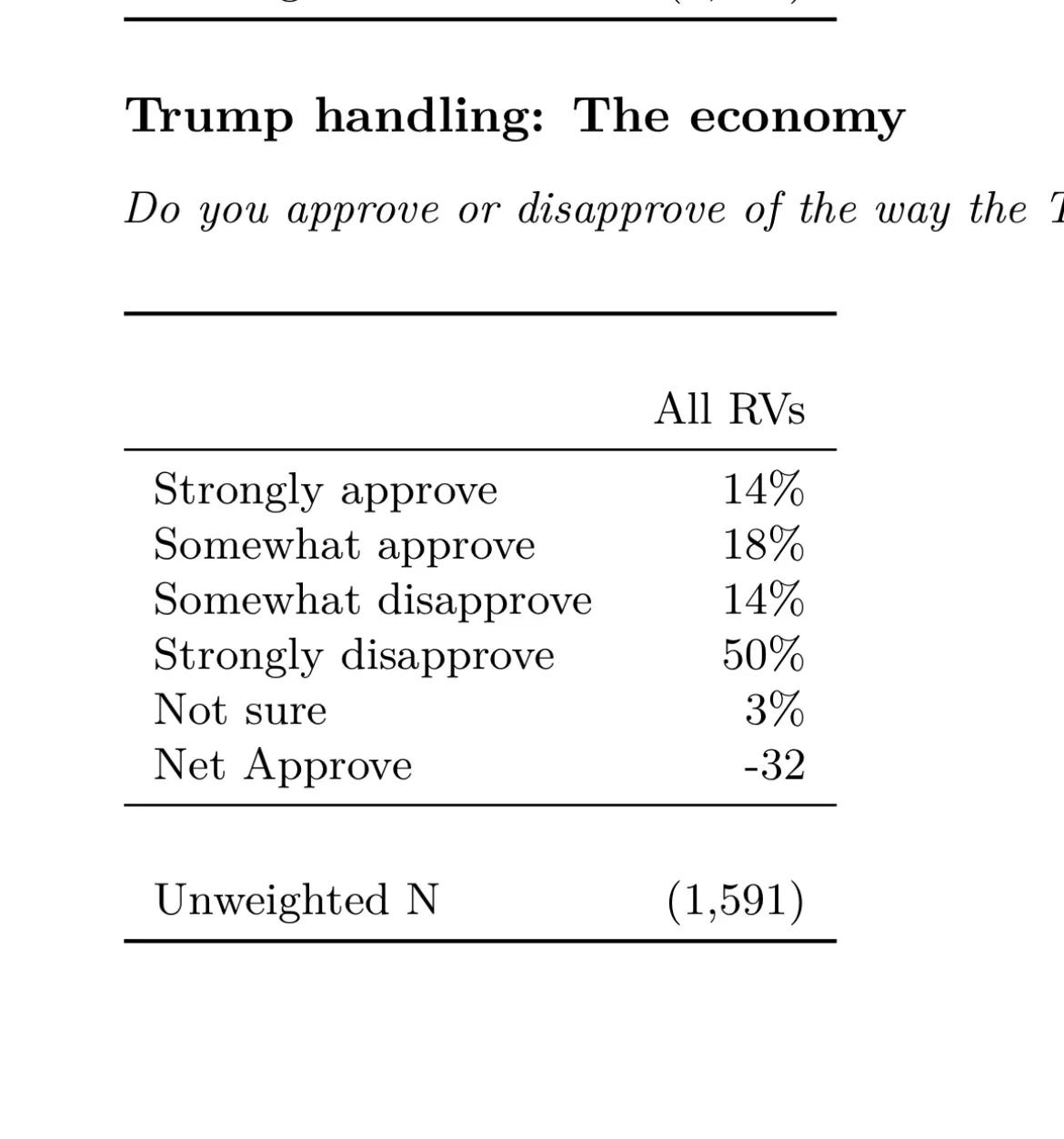
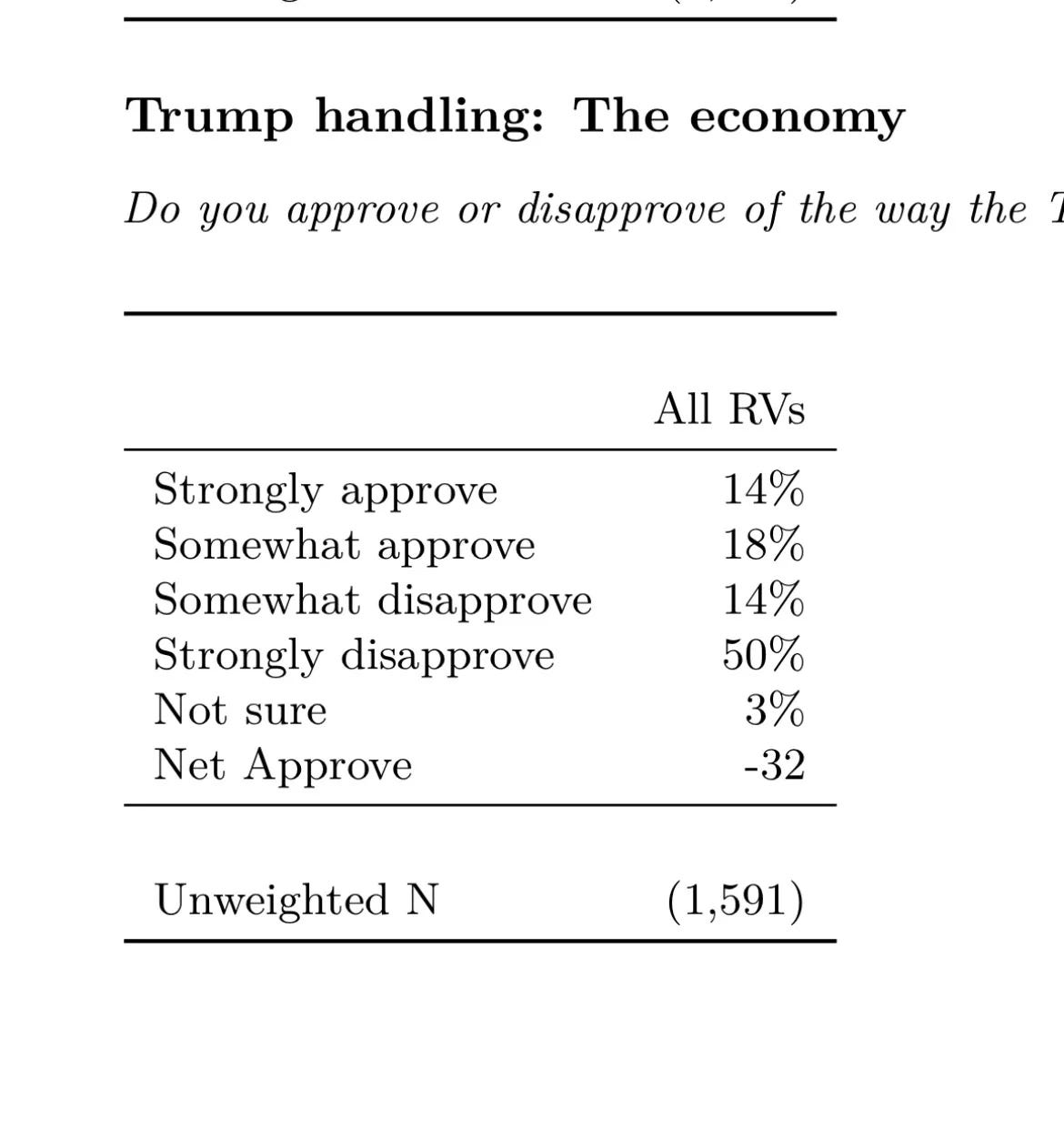
And finally, Trump’s approval on handling the economy is at just 32%, with 64% disapproving, among registered voters, my new poll finds. Trump is net negative on handling deportations and border security in this survey.
And that’s it for this week! Thanks for reading. Strength In Numbers will be back in your inbox on Tuesday-Wednesday with the weekly deep dive for premium subscribers.
Got more for next week? Email your links or add them to the comments below! Comments are unlocked in the Sunday roundup.
1 out of 6 wouldn't vote for him again; that means 5 would. Honest to God it's baffling.
Serious typo: “According to the new poll, only about one in six Trump voters say they’d support him in a redo election”