


This is my weekly Sunday roundup of new political data published over the last seven days. It is free to read, but if you want to support independent data-driven political journalism, become a paying subscriber and get additional data journalism and premium analysis at least once weekly.
Dear readers,
It’s going to be a big week here at Strength In Numbers and sister publication FiftyPlusOne.news. After working in stealth mode on a few “big swing” projects for the last 3-4 months, our small-but-mighty team is releasing our first original interactive for the 2026 midterms in the next few days. Watch this space.
I’m also hard at work finalizing the questions for our August monthly poll with Verasight. If you have any questions you think would make a good piece, drop me a line. The reason we’re doing public polling through the newsletter is to ask questions that are more in tune with voters’ concerns than elites’.
In the meantime…
Leading off: A reader asked me this week what Mainers think about ICE. Because we now have the new state and congressional district MRP pipeline here at Strength In Numbers, I can answer this question — and not just for Maine, but every state in the country. I take a look at how past Strength In Numbers/Verasight polls on immigration and deportation break down at the state level.
And, on deck this week: Tuesday’s Deep Dive will be about Trump getting “squeezed from both ends” — his own voters are cooling on him while independents move toward Democrats, and Democrats are fired up against him and the GOP. This it shows up on poll questions about approval, the generic ballot, and issue trust.
Thank you for reading Strength In Numbers for another week! On with the data.
If you’re not subscribed yet, enter your email here to get these in your inbox.
1. Mass deportations are unpopular in every swing state
Strength In Numbers reader (and collaborator!) Mark asked me on Friday what public opinion on Donald Trump’s immigration policy and deportation agenda is currently looking like in Maine. This is relevant for a few reasons. First, last month, federal ICE agents in Maine killed a 26-year-old man who was not a target of immigration enforcement operations. Second, there is a competitive Senate race in Maine this year. And third, U.S. Senator Susan Collins is trying to distance herself from her voting record on immigration and ICE, which we’ll see more about.
Thanks to about a year’s worth of R&D in my spare time, we now have the infrastructure here at SIN to estimate how people in each state and congressional district feel on any question asked in our monthly survey with Verasight. (We can also ask new questions and run them through the same algorithm.) Mark asked about approval of ICE in general, which we have not asked — but we did ask five other questions about immigration and deportations that I think are otherwise illustrative.
Here’s how registered voters in every state feel about ICE and Trump’s deportations agenda, across five questions:
Approval of Trump’s handling of deportations
Easy questions first. As part of our issue-approval battery, we ask Americans each month how they feel about Trump’s handling of deportations. The text of the question is:
For each of the following issues, please tell us whether you approve or disapprove of the way Donald Trump is handling… — Deportations
And respondents are asked to pick one of four options: Strongly approve, Somewhat approve, Somewhat disapprove, Strongly disapprove — or Don’t know. After removing the Don’t Knows, registered voters in July split about 10 points against Trump’s handling of deportations nationally. Here’s what approval looks like in every state:
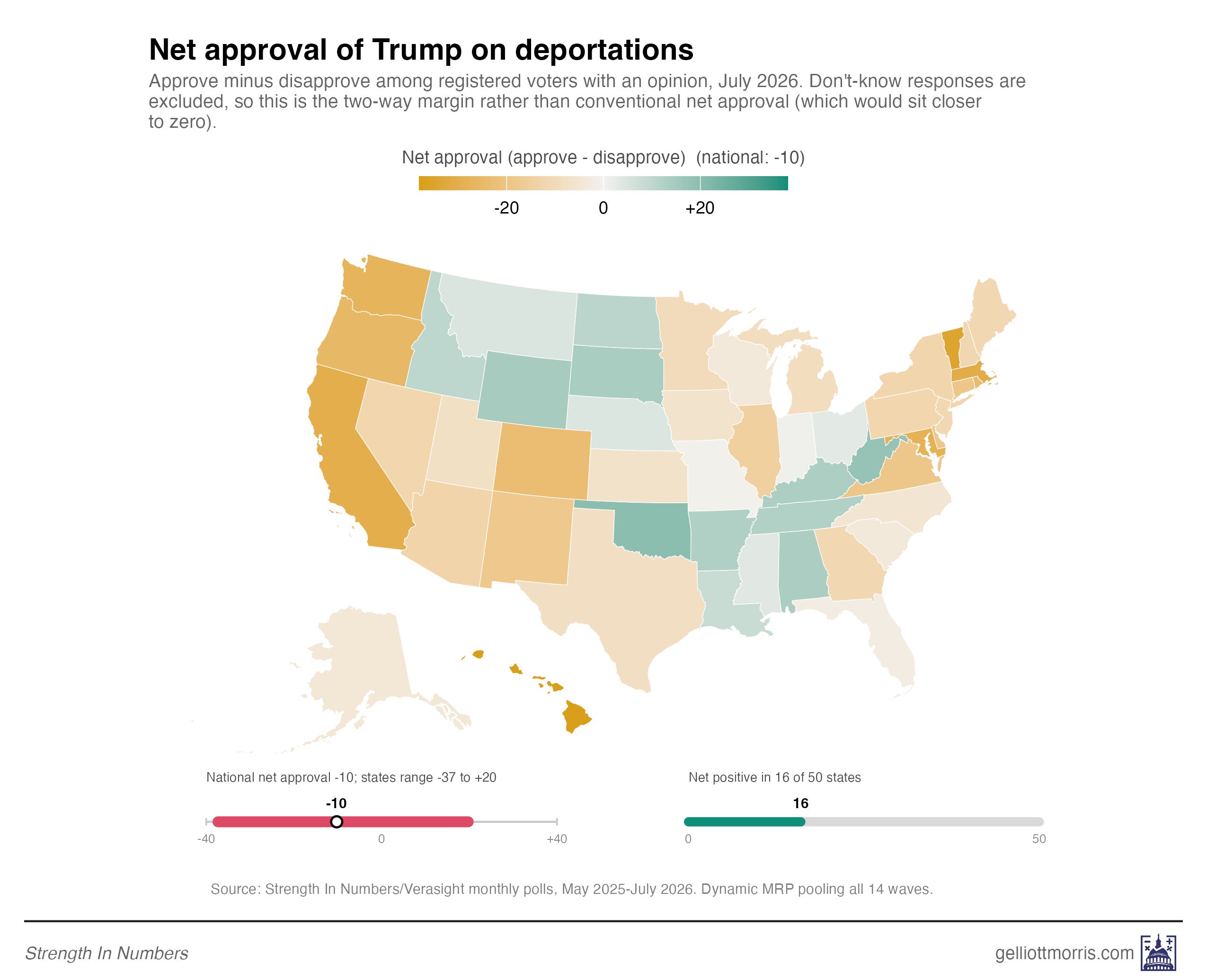
The range of net approval on Trump’s deportations policy runs from +20 in Oklahoma to −37 in Hawaii. In total, just sixteen states are above water, along with 160 of 435 congressional districts. Trump is underwater on deportations in 34 states, including all the swing states plus Florida, Texas, Iowa, and Alaska — all states with elections for U.S. Senate this year.
Maine, the subject of this article, is at −11 on net.
Additional funding for ICE is also unpopular
We asked the following question in July 2025, in the midst of the fight in Congress over Trump’s “One Big Beautiful Bill.” At the time, I reported that the OBBBA may have been the most unpopular budget law of modern history.
Here’s the question wording:
The Republican budget increases spending on the Department of Homeland Security, which contains both the Customs and Border Protection (CBP) and the Immigration and Customs Enforcement (ICE) agencies, by $170 billion. The money is meant to fund construction of new detention facilities for immigrants, including for families, as well as the training of new CBP and ICE agents, and additional infrastructure along the U.S.-Mexico border. Do you support or oppose this additional funding for immigration and border enforcement?
Respondents could choose between Support, Oppose, or Don’t know/not sure. Here’s the national map:
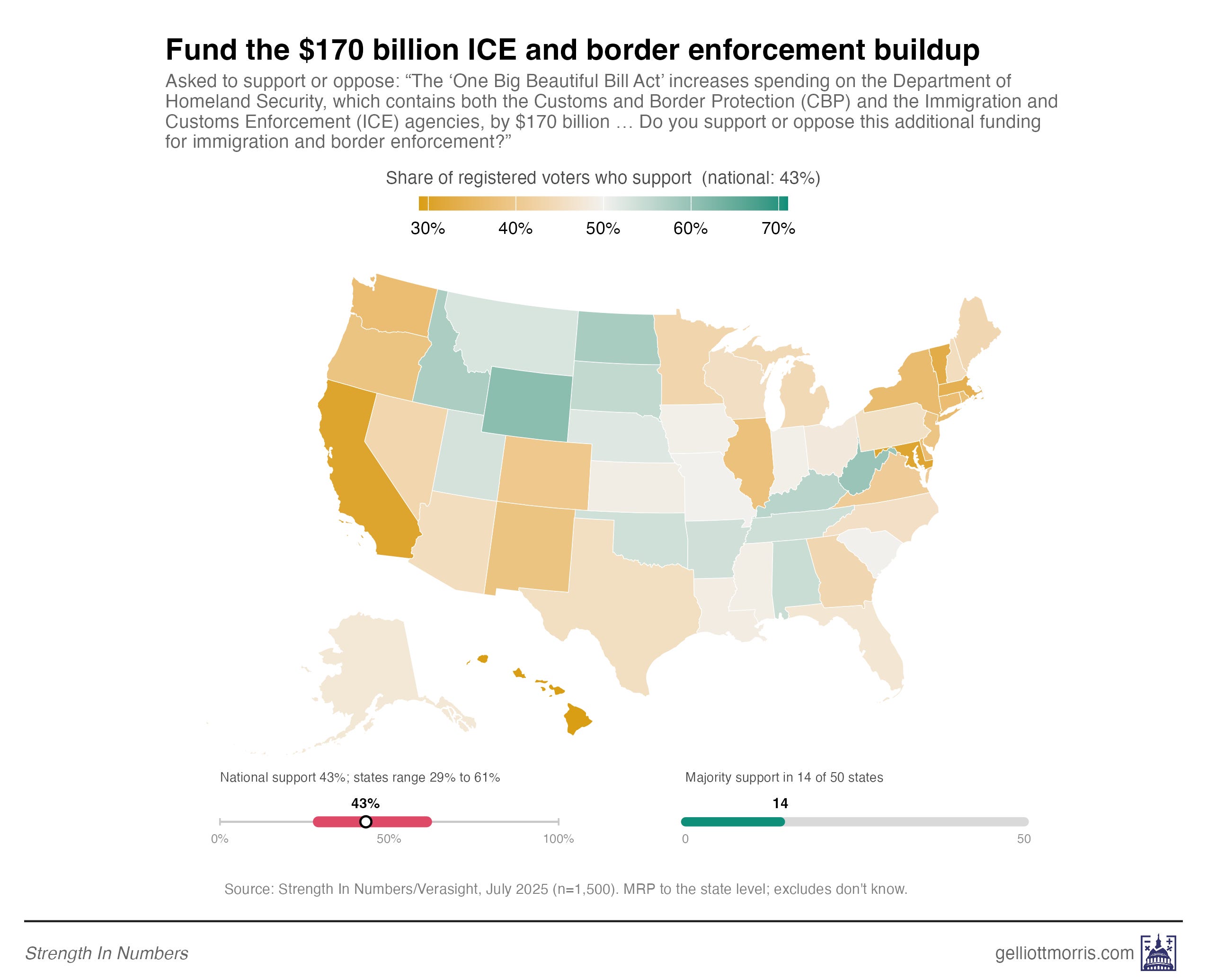
Among registered voters nationally, 43% supported the 2025 OBBBA’s ICE funding provision. Support was as high as 61% in Wyoming and as low as 29% in Hawaii, and wins the majority (of people with an opinion) in just 14 states. Support for the OBBBA’s immigration funding in Maine was at 44% in our poll.
Given how the immigration opinion landscape has changed since last July, these numbers should be considered optimistic for Republicans. After the shootings in Minnesota earlier this year, and in Houston and Maine last month, support for ICE is significantly worse now.
Low opinion of how enforcement operations have been run
Now, when we move from asking questions about abstract concepts, like approval of how the president is handling an issue, to those about real events or enforcement patterns over the last year, opinion moves quickly against the president.
For example, we asked this question in March 2026:
Do you approve or disapprove of the way the Trump administration has handled domestic immigration enforcement operations {like the one in Minneapolis, Minnesota}?
The options were Approve, Disapprove, and Don’t know.
Here’s the map:
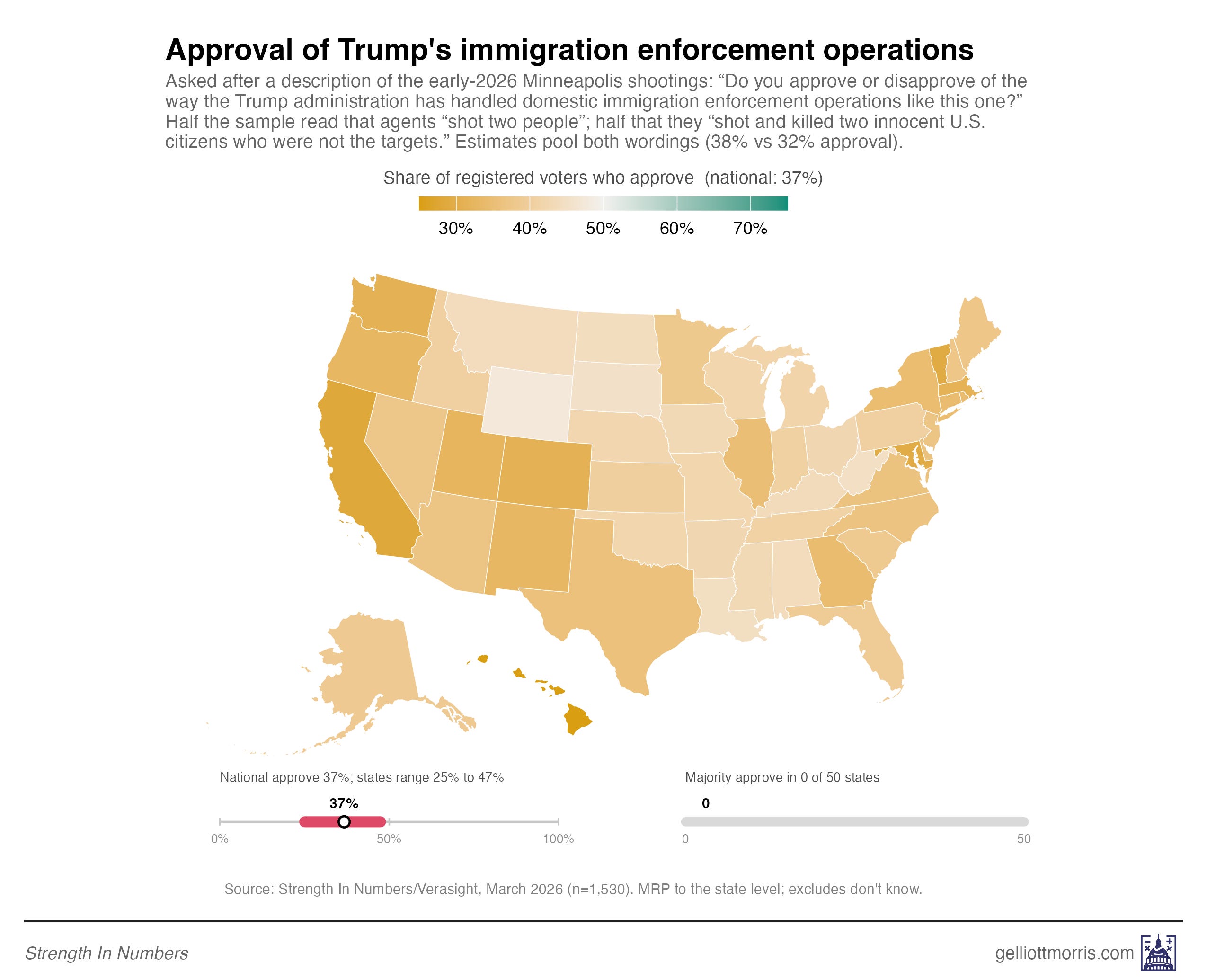
No state’s estimate reaches 50%. Maine is at 37% approve.
Deport everyone, or a path to citizenship?
In November 2025, we asked people to take a side on deportations:
Which comes closer to your view about undocumented immigrants who have lived in the U.S. for at least five years, even if neither is exactly right?
Deport all immigrants who are in the country without legal status, regardless of how long they have lived here.
Create a legal path to citizenship for immigrants who have lived here for at least five years and who meet certain requirements (such as never being convicted of a crime).
Here’s the map. Orange in this case is used to show states where a path to citizenship is more popular than deporting everyone here who is undocumented.
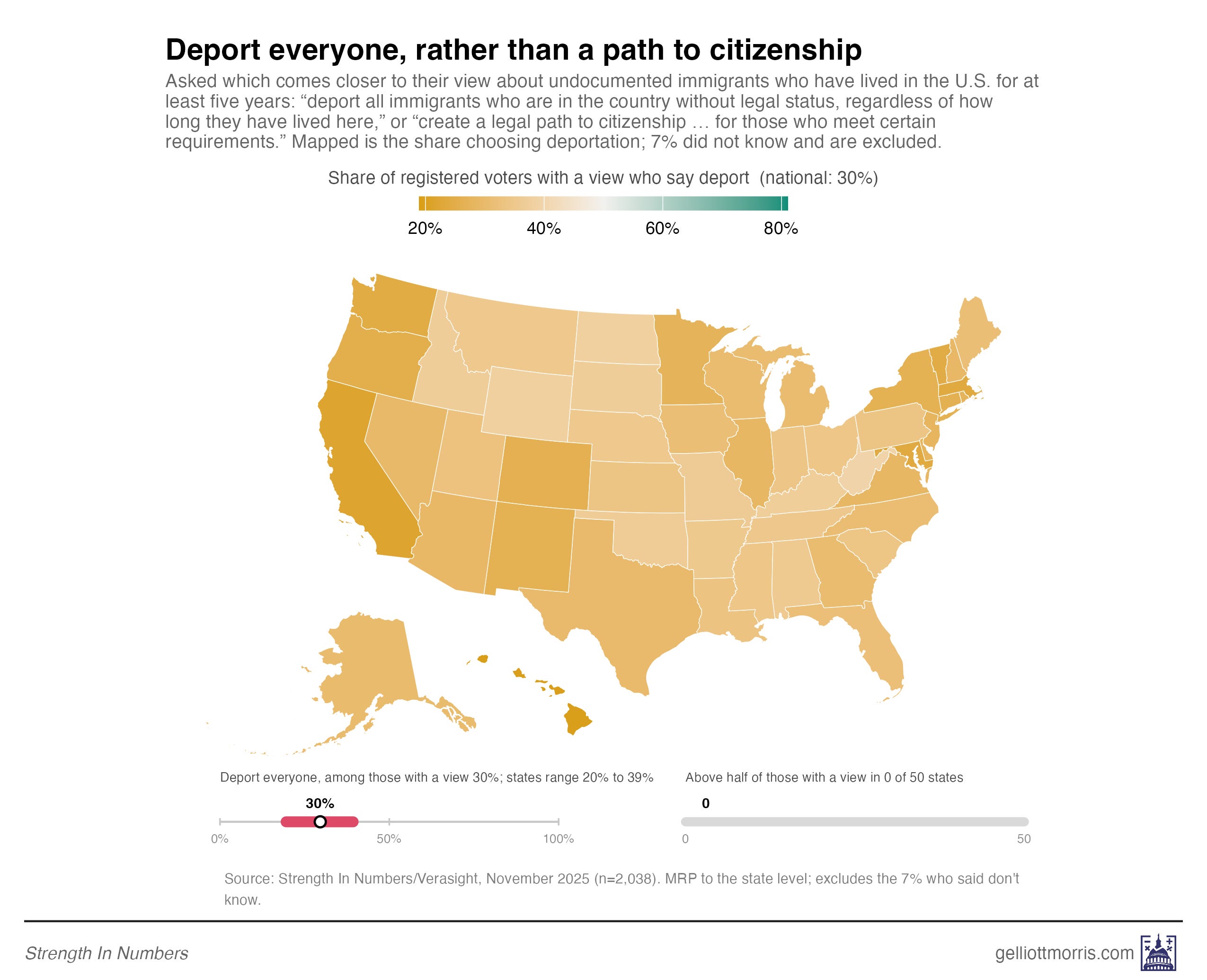
Not one state prefers deporting everyone once voters are given an option to give citizenship to non-criminal long-term immigrants.
Deporting people without a hearing
Finally, we asked this question in February 2026:
Do you think immigrants arrested by the federal government should have the right to appear before a judge before being deported, or should the government be able to deport them without a court hearing?
This question was in response to the in-the-dead-of-night removal of dozens of immigrants in defiance of a judge last year, and of the Trump administration’s expanded use of a policy called “expedited removal” to deport people here illegally without seeing a judge.
Respondents could say that people being deported should appear before a judge, or that the government should be able to deport them without a court hearing. As above, I have removed those who said “don’t know” (this is necessary to get the MRP model to run properly).
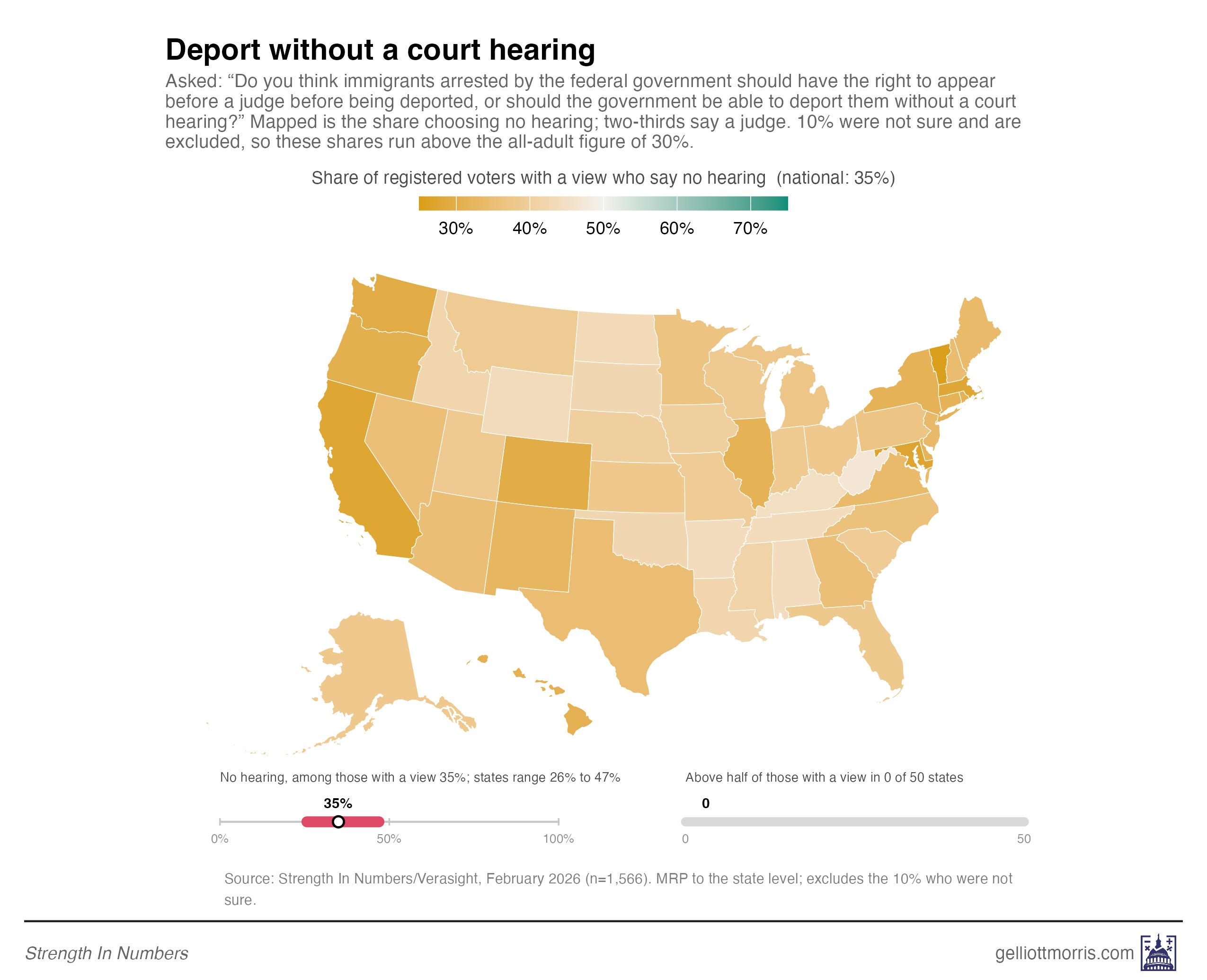
Again, the map shows the administration’s side in green. Nationally, 35% of registered voters with a view would let the government skip the hearing — whereas 65% oppose expedited removal. Maine is just left of the national average at 34% approval for deporting people without giving them a hearing.
The Trump administration is really weak on questions of due process, especially for long-term migrants.
What this means for the Maine Senate race
Mark’s question to me was in response to a thread from New Republic writer Greg Sargent, who argued on Friday that Democrats need a plan to show Maine voters how Susan Collins is being hypocritical on ICE. Sargent wrote his piece after Semafor reported that Collins “secured a commitment” from ICE chiefs that all officers will now wear body cameras during enforcement operations — something she voted against in June.
Sargent says Collins, after voting for increased ICE funding and shooting down additional enforcement guardrails, shouldn’t “have a clear field on TV to sell herself as a moderate on ICE.”
I’m not sure if Mainers will buy Collins’ abrupt pivot on the issue. But certainly the whole saga illustrates how foolish the argument from certain centrist Democrats is that the party needs to move right on immigration and “not talk about” the issue. Here, in a competitive Senate race, we have a real-world example of how Republican lawmakers are perceiving the public opinion on the immigration issue now — and they’re not acting like the people are on their side!
Sargent cites a CNN poll having Trump 22 points underwater on immigration enforcement. Our own poll is around -12, but that’s still a starkly negative number for an issue Republicans have historically led on.
Collins knows this, which is why she’s claiming credit for body cams. Sargent is right that it’s hypocritical, and I imagine Troy Jackson, the state’s new Democratic nominee for Senate, will prosecute that argument.
But the hypocrisy is the less interesting part. With Collins claiming credit for body cams, we are seeing high-profile, electorally vulnerable members of the president’s own party campaigning on reining in his signature policy. That’s because Trump’s immigration agenda is decisively unpopular, and she knows it.
Strength In Numbers has generally been ahead of the curve in seeing the pattern of, and danger in, elites overestimating Trump’s support among the American people. That has been truer on immigration than most other issues.
2. What Strength In Numbers published last week
Last Sunday’s roundup looked at what it would actually take for Democrats to win over more midterm voters:

On Tuesday, an exclusive GQR poll shared first with SIN found independent Seth Bodnar beating Republican Kurt Alme 50-44 in a Montana Senate head-to-head, while a four-way field handed Alme the win at 41-27. The uncomfortable implication is that Democrats may do better in some states by not running anyone at all:

The podcast returned on Thursday, digging into what’s behind Trump’s new all-time low approval rating:

And on Friday, the Chart of the Week: gas prices fell in June, and Trump’s approval on inflation didn’t follow. His overall approval hit a new low — 36-61, a net −25. Biden learned the same lesson — voters respond to what things cost, not to the rate of change:

If you’re a frequent reader of Strength In Numbers, I’m confident you will get a lot of value out of a paid subscription. You’ll get access to all of my Tuesday Deep Dives, monthly polling data, our private community of election nerds on Discord, and more.
New at The Data Lab
One thing went up in the Data Lab this week — the corner of the site for notes on polling methods and the wonkier work I don’t send to the full email list. It’s free, and it’s a useful companion to today’s lead story about how much survey weights affect (or rather, don’t) our MRP estimates:

And for additional reference, here’s the announcement post of my revamped MRP model, with tons of charts of congressional-level public opinion, from Monday:

3. Even more numbers!
Data for Progress finds Democrats who take AIPAC, AI, and crypto money underperform the ones who reject corporate PAC cash. AIPAC, AI, and Crypto-Funded Democrats Underperform Democrats Who Reject Corporate PAC Money
Related to the anti-system axis?
Even Trump’s own voters are lukewarm on the GOP tax overhaul, which is a problem when it’s your signature accomplishment. Poll: Even Trump voters aren’t very impressed by the GOP’s tax overhaul
The Downballot has a new method for spotting when the electoral environment shifts — it catches moves like Dobbs within about five special elections. Worth reading if you follow the specials closely. Special elections can tell us when the electoral winds are changing — faster than ever before
Sabato’s Crystal Ball moved 13 House ratings toward Democrats. Thirteen House Rating Changes Toward Democrats
Decision Desk HQ says James Talarico is polling better than Beto O’Rourke did in 2018
Good graphs in this Times piece on the MAGA media coalition coming apart over Iran and the economy. The MAGA Media Machine Is Fracturing
This is from March but I only saw it this week: It’s 3 times harder for blue states to get disaster funding under Trump
Ariel Edwards-Levy has a good thread of findings from CNN’s latest poll, which focuses on interesting stuff that’s not the horse-race.
And that’s it for this week! Thanks for reading. Strength In Numbers will be back in your inbox on Tuesday.
Got more for next week? Email your links or add to the comments below!
Just the maps on "deporting without a hearing" and "mass deportation vs a path to citizenship" made my eyes water with hope that we are not descending into utter fascism (yet).
I am relieved and grateful that so many Americans still believe in due process of law.
And the fact that this administration clearly does NOT will hopefully lose them lots of votes come November.
Question: what would the generic congressional ballot need to be for Democrats to have a shot at a filibuster proof majority in the Senate? That would be a pick up of 13 seats, and would go beyond the swing states, and those currently considered competitive. My own analysis indicates D +18. But, I would like to know what the real numbers people think.