


This is my weekly Sunday roundup of new political data published over the last seven days. It is free to read, but if you want to support independent data-driven political journalism, become a paying subscriber and get additional data products and premium analysis at least once weekly.
Leading off: A new YouGov poll shows MAGA and non-MAGA Republicans splitting on the Iran war, the economy, And especially inflation. That matters because non-MAGA Republicans are exactly the voters Trump needed to assemble his 2024 coalition, and he’s losing them on the issue they care about most.
On deck this week: It’s poll week here at Strength In Numbers! Toplines and crosstabs come out Tuesday, with more data on Wednesday, and a deeper dive into the Democratic Party’s favorability/perceptions issues on Thursday.
The latter will be part of this week’s recording of the Strength In Numbers podcast with me and David Nir — live and in-person in Washington, DC! We’d love it if you’d join us!
Our session will take place on Thursday, April 23, at 11:15 AM at the America Votes Summit, which is being held at the Walter E. Washington Convention Center (the address and directions can be found here). We will be breaking down the current state of the midterms using data, and also have an exclusive new poll explaining current sentiment toward the Democratic party. We’ll be taking your questions in an extended Q&A session!
The first 75 listeners who RSVP can attend free of charge. Just click below:
We really hope to see you there, and we’d love to chat with you after the show, too!
On with the data.
1. Non-MAGA Republicans are breaking on Iran
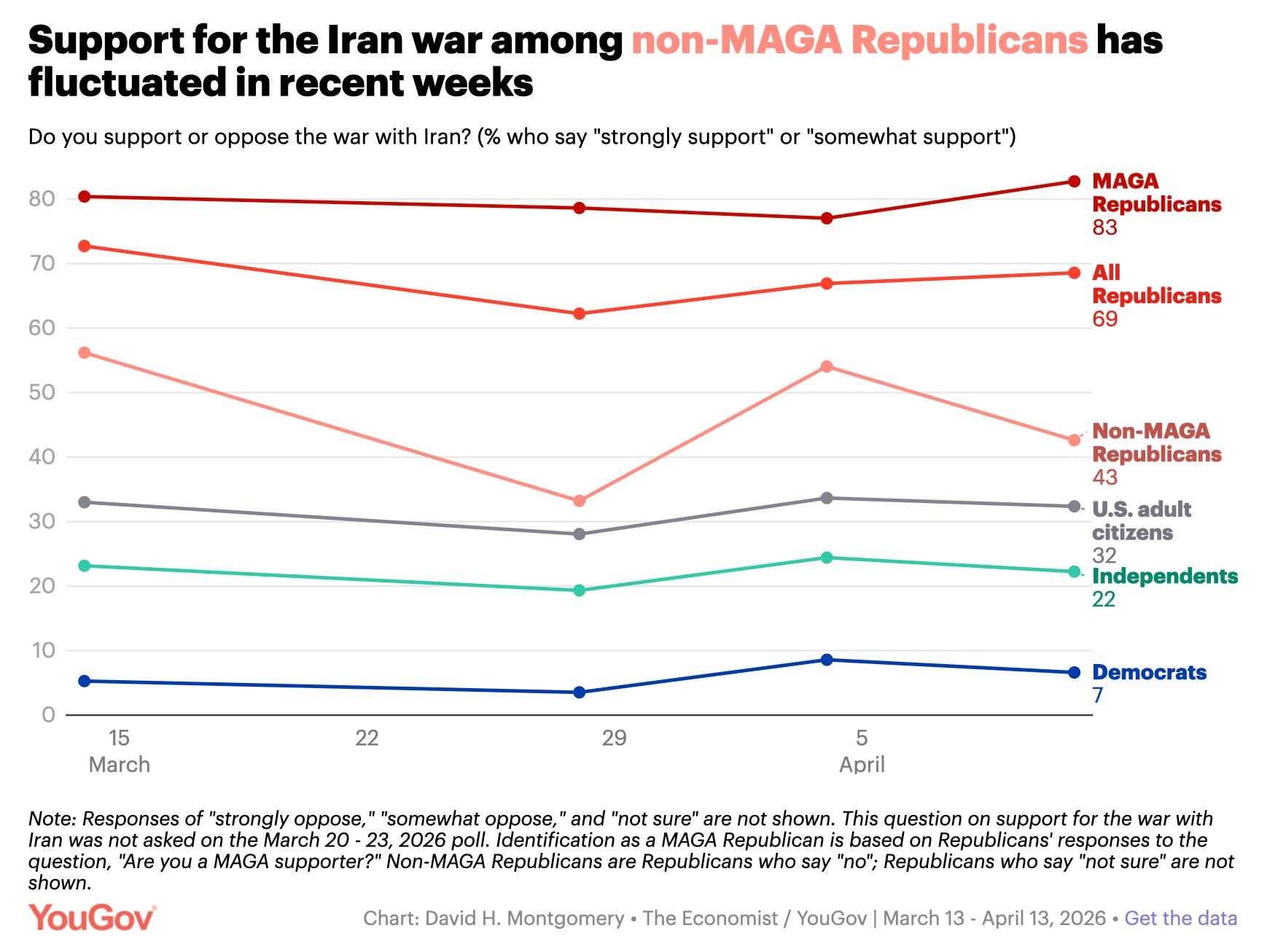
A new YouGov/The Economist poll out this week shows MAGA and non-MAGA Republicans splitting sharply on the Iran war. Remember their polling shows about half the party calls itself “MAGA.”
This reminds me of a chart that David at YouGov rendered for me (when I somewhat manically emailed him about the MAGA/non-MAGA divide) last month:
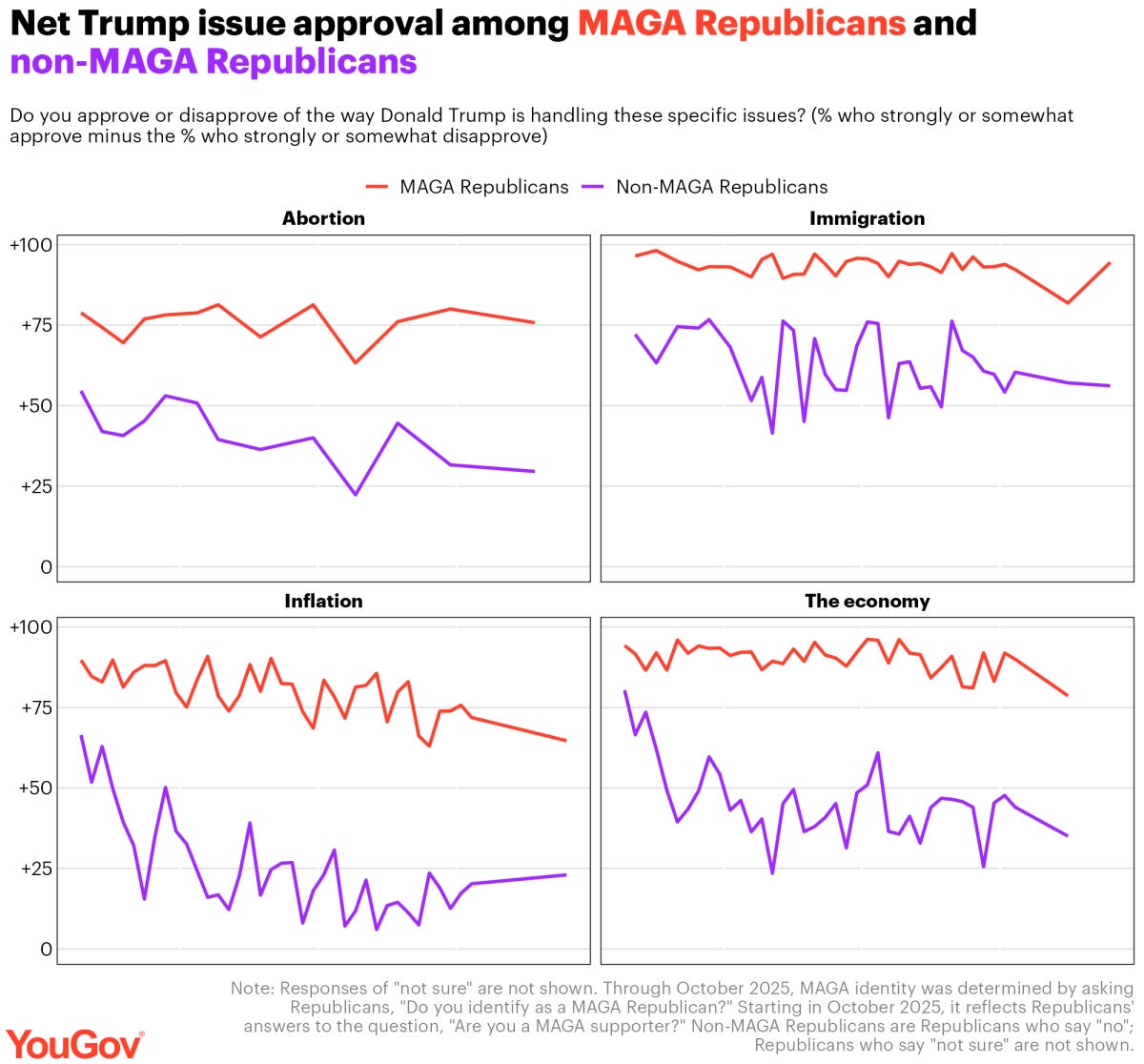
Note that there’s usually a pretty consistent divide between MAGA and non-MAGA Republicans, and the two groups tend to move toward Trump and away from him in similar numbers at the same time.
That’s not what’s happening on Iran. Non-MAGA Republicans are moving against Trump in big numbers, and MAGA voters are standing pat.
But Trump is particularly weak with non-MAGA Republicans on inflation. The gap between MAGA and non-MAGA approval is wider there than on almost anything else, at about 40 points on average over the last 3 months. And non-MAGA Republicans are by definition exactly the voters inside the GOP who matter most electorally. On the issues these voters say matters most to them, Trump is pursuing exactly the strategy that could help him.
This ties into an MS NOW interview I did on Saturday. Trump’s 2024 coalition was built on four pieces. The core is the roughly 30–35% of Americans who are MAGA on any given policy. But the base alone doesn’t win elections. Trump won by adding three other groups: non-MAGA Republicans who are negatively polarized against Democrats and would never vote for them; swing voters who soured on Kamala Harris for ideological or personal reasons; and voters who were simply fed up with the economy and wanted the other party in charge.
Looking at the polling, Trump has lost a little ground with his base and with the reluctant Republicans. But he’s losing real ground with the Harris-skeptics and the economy voters — and he’s losing it on the issue those groups say matters most.
This is why MAGA is not an enduring, winning political movement.
2. What Strength In Numbers published last week
Tuesday’s Deep Dive made the case that consumer sentiment is low because “excess prices” — how far prices have overshot their pre-COVID trend — dominates how people think about their personal finances today, and that standard economic models miss this factor:

Thursday’s podcast previewed early findings from our April Strength In Numbers/Verasight poll and walked through the excess-prices framework and why neither party has a quick political fix to this problem:

Friday’s Chart of the Week followed up with eve mode modeling of consumer sentiment, this time around a new inflation-delayed excess prices measure I backtest back to the 1960s built around excess prices:

Also: On Friday, I wrote over at 50+1 with my colleague Mary Radcliffe about how “soft” measures of Trump’s support are eroding among Republicans. I don’t usually cross-post the 50+1 stuff here to SIN, but this article is on the same subject as this week’s roundup and think you should check it out!

If you’re a frequent reader of Strength In Numbers, I’m confident you will get a lot of value out of a paid subscription. You’ll get access to all of my Tuesday Deep Dives, monthly polling data, and more.
3. Even more numbers!
A handful of things I read this week.
The Economist Intelligence Unit’s latest democracy index suggests the global democratic recession may finally be easing — the scores of nearly three-quarters of countries held steady or improved last year, and the global index posted one of its biggest annual increases since 2012: Global democracy is in better shape than you think
Arin Dube shows that four Republican-leaning states (Arizona, Florida, Missouri, Nebraska) raised their minimum wages to $13–$15 via ballot initiatives — and restaurant and retail employment didn’t take a hit: These Republican-leaning States Went Big on Minimum Wages
75% of U.S. adults say they’ve read all or part of a book in the past year, per Pew — and print still beats digital and audio: Do Americans read print books, e-books or audiobooks more?
Charles Franklin’s direct comparison of Trump first-term vs second-term consumer sentiment: first 23 months of term one averaged 97.5 on the Michigan index; term two is averaging 55.5: Second Term Worse than the First
One more thing. I’m looking for people to help me stress-test something I call the “2026 Senate Simulator” that I’ve been quietly building for a few weeks. It’s an interactive tool for exploring the Senate landscape -- part education, part fun, and not a full election forecast. You can tweak the underlying assumptions of the model (national environment, value of incumbency, state-level partisanship, etc.) and watch the Senate map shift in real time.
You can try the 2026 Senate Simulator here. Let me know what you like, what’s confusing, what’s wrong, etc. And let me know especially if you think something is missing that would otherwise make this better!
And that’s it for this week! Thanks for reading. Strength In Numbers will be back in your inbox on Tuesday.
Got more for next week? Email your links or add to the comments below!


Years ago, Washington state passed a referendum increasing the minimum wage and indexing it to inflation. It won in e dry part of the state. Raising the minimum wage is just about the most popular thing legislatures and Congress can do. That it doesn’t happen shows as much or more than anything else the power of corporate and business lobbying.
30-35% who support you no matter what seems like an enduring political movement because it is not that hard to garner another 15-20% (and maybe 20% not necessary because of the structural advantages of big square states). But if the dumbass who is king does everything possible to scare off the 15% that is costly to the movement. No tariffs or war and MAGA is an enduring political movement despite torturing the undocumented, putting the most ill equipped people into cabinet positions and the corruption. Sounds like an enduring movement.