My weekly Friday column is free to read, but it is not free to produce. Become a paying member today to support work like this and all the original data Strength In Numbers publishes.
I had intended to publish a wonky Chart of the Week for today about why I think this article by Charlie Cook overstates the impact of partisan sorting and understates Democrats’ chances for the midterms… but then the news cycle got in the way. The piece got pretty “weedsy” anyway, so it’s probably better as a Deep Dive for premium subscribers. I have scheduled it to publish next month while I’m out on paternity leave.
To take its place, the news gods have given us the Democratic National Committee’s “autopsy” of the party’s defeat in the 2024 election. There is a lot of controversy surrounding this report, mostly stemming from the fact that the current DNC chair promised to release it when he was running for his position in 2025 and then abruptly changed his mind after winning. He apparently flip-flopped back to publishing the report yesterday after CNN got a hold of portions of it.
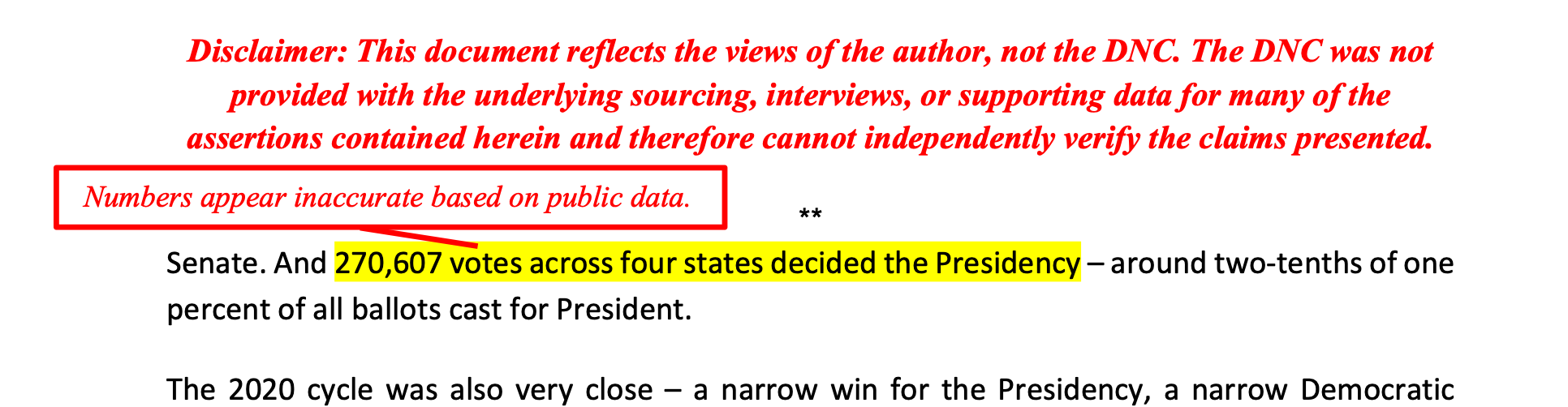
Unfortunately, there is little to learn from the autopsy. The story is mostly about what’s not in it, which I’ll get to. As for what is included, start with the fact that it contains many factual errors (this is a “draft” report and they they presumably would have been caught in a full copy edit, but still), as evidenced by warnings such as the one below that appear on nearly every page:
The autopsy does not really present a unified theory of why Kamala Harris lost in 2024. The unnamed author writes, among other things, that the party moved too far left and failed to define Trump and go negative effectively. But it arrives at these conclusion with a surprising lack of new research, and with a lot of pundit conventional wisdom and “analysis” you’d expect from someone committing the Strategist’s Fallacy. I don’t know how much the DNC pays for reports like these, but presumably if it really wanted to understand why Harris lost, it would want to invest some resources into fact-finding research like surveying state party chairs and local officials, as well as talking to voters who switched sides. Maybe it could even do some original causal research on its theories.
But the biggest problem is that the autopsy straight up ignores the major reasons Harris lost in 2024. Yes, it’s bad enough that the report doesn’t mention that party bosses failed to coordinate an early exit for Joe Biden, who was too unpopular to win. And there is no mention of Israel/Gaza, low turnout in the cities, and nothing on Harris’s race or gender. But this is a data-driven site, so I want to really focus in on what the numbers can tell us.
When we boot up the data, it’s obvious the main reason Harris lost — and the reason I am going to explore here, at this website, it being a data-driven website — is that 2024 simply had too much inflation-induced anti-incumbent sentiment for the incumbent party to overcome. This is curiously missing from its main diagnosis. The word “inflation” isn’t mentioned in the autopsy a single time (except in the context of inflation-adjusted ad spending).
This week’s Chart of the Week is about the real reason Democrats lost in 2024.
The fundamental(s) issue
The reality of the 2024 election is that it was going to be hard for a Democrat to win, regardless of who they were or how they campaigned. The broader economic and political conditions were so favorable to Republicans that you would have expected Trump to win about 90% of the time, regardless of campaign or candidate effects.
Political scientists have been pointing out for decades that you can predict presidential elections reasonably well using just two pieces of information: how voters feel about the incumbent president, and how voters feel about the economy. There are many variants of this model — such as the “Bread and Peace” model (Douglas Hibbs), the “Time for Change” forecast (Abramowitz), Ray Fair’s “Fair” model, and Wlezien/Erikson’s work with “Leading Economic Indicators” — but all use a similar set of economic and political “fundamentals” to predict the result of the election.
None of these models is perfect, but they’re a useful baseline for forecasting elections and understanding why certain results happen. One use of the predictions is to distinguish the part of an outcome that’s about candidates and campaigns from the part that’s structural.
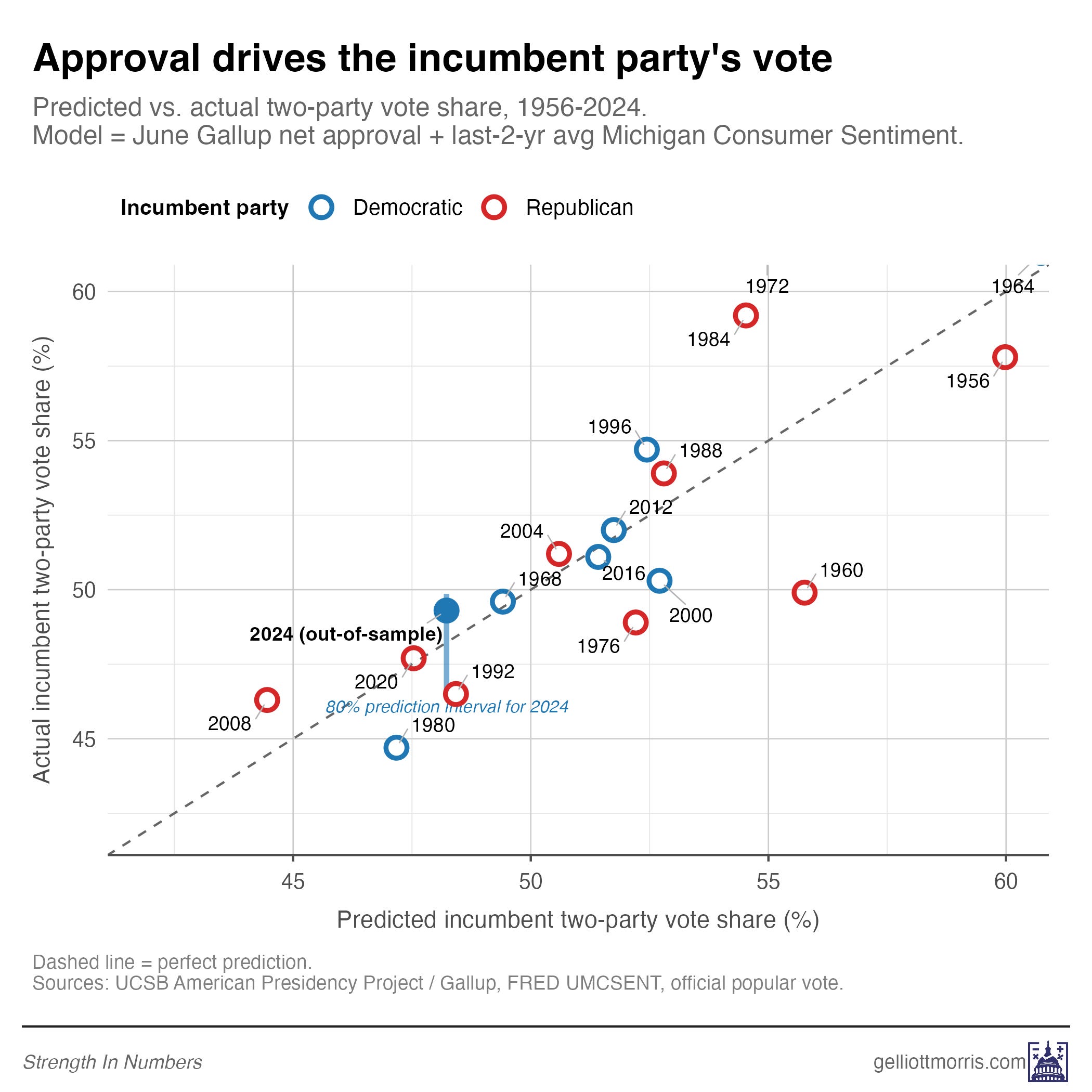
The chart below shows a model I built for exactly these explanatory purposes. It uses Gallup’s net approval of the incumbent president measured in June and the trailing two-year average of the University of Michigan’s Consumer Sentiment Index to predict the incumbent party’s share of votes cast for the Democratic and Republican candidates for president — what we call “two-party” vote share. That’s it: two variables, both measured before Labor Day, both knowable months before any ad runs, and in some cases, before candidates are even picked.
The dashed line is a perfect prediction. The shaded line shows the 80% prediction interval for the 2024 election, and the solid blue dot shows the actual result of the race.
In 2024, Kamala Harris received about 49.3% of the two-party vote. The model — fit on data from 1956 through 2020, with 2024 held out — predicted she’d get about 48%, with an 80% prediction interval of 46.6% to 49.9%. Harris’s vote share lands on the upper end of this range, but still squarely inside of it.
In a sense, then, the surprise of the election is that Harris did as well as she did, considering the prevailing factors against her. Given Biden’s approval rating in June (deeply underwater, in the high 30s) and two straight years of the worst consumer sentiment readings outside of a recession, the Democratic nominee was on track to lose the popular vote by 4 points. She lost by 1.5.
Contrary to the autopsy and Strategist thinking, you don’t need a theory about Harris’s past issue positions, or whether the campaign spent too much on broadcast and not enough on connected TV, or whether Future Forward (a Democratic Super PAC) and the campaign had aligned strategies, to explain the 2024 outcome. The fundamentals already explain it.
I have found that people don’t like giving or hearing this explanation for election results. I recently tried at a meeting with congressional staffers, and I think it left them dejected and/or upset, because it left them with few action items besides “run anti-incumbent candidates when the economy sucks.”
Another reason consultants don’t focus on structural factors more often is that they can’t sell you any services to solve that problem, because there’s nothing you can do about them.
But generally speaking, “inflation was high, and Harris was going to lose anyway” is a much better explanation for 2024 than anything else in isolation. Since we have the track record of this inference, and it has been helpful historically, we can also be confident it will continue to be helpful in predicting future elections. A lot of the other explanations people are giving about 2024 don’t extrapolate well to future elections (”we should align the campaign’s interests with its Super PACs” — what? duh!).
Incumbents did poorly everywhere in 2024
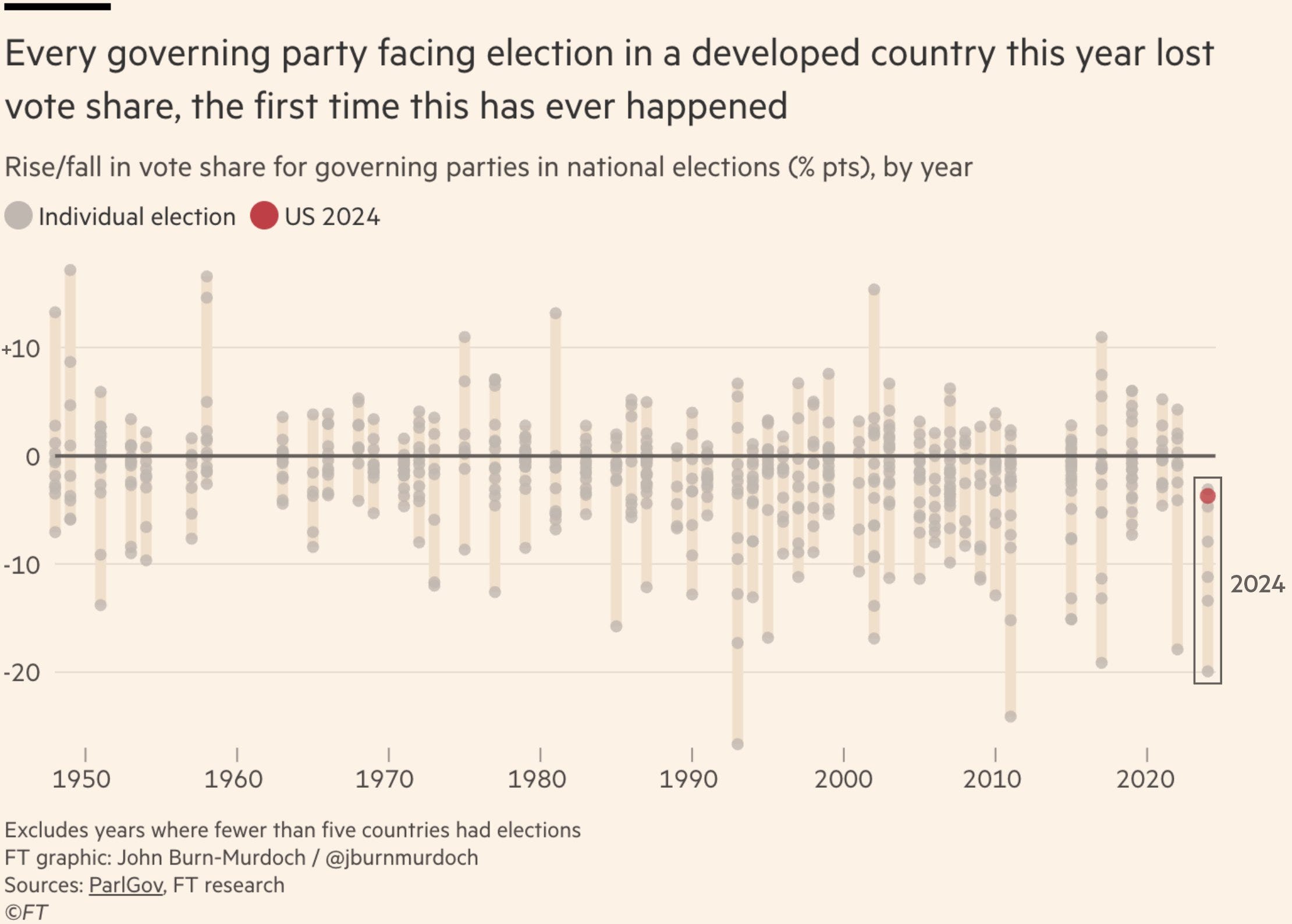
If you only read the DNC report, you’d think 2024 was a uniquely American failure of Democratic messaging, organizing, and candidate definition. And maybe you don’t buy my “fundamentals” regression of election outcomes. Well, to that person I’d emphasize that 2024 wasn’t just bad for Democrats; it was bad for incumbent parties all across the globe.
As data journalist John Burn-Murdoch documented in the Financial Times, every single governing party in a developed democracy that faced voters in 2024 lost vote share. The Tories were obliterated in the UK. Macron’s coalition lost its majority in France. The LDP lost its majority in Japan. And on and on. Incumbents from Portugal to South Korea either lost outright or were badly weakened.
What did all these countries have in common? Not Kamala Harris’s communications strategy. Not the Democrats’ rural organizing budget. Not whether the party had gone “too far left” on social issues. They had inflation. The post-pandemic price shock hit virtually every developed economy, and voters everywhere punished whoever happened to be holding the gavel when prices went up.
Burn-Murdoch said on Twitter/X the day after Trump won:
We’re going to hear lots of stories about which people, policies and rhetoric are to blame for the Democrats’ defeat.
Some of those stories may even be true!
But an underrated factor is that 2024 was an absolutely horrendous year for incumbents around the world.
This should give the structural theorists more ammo in rebutting the autopsy truthers. When incumbents lose across dozens of countries with different parties, different candidates, different media environments, and different campaign tactics, the parsimonious explanation should be the one variable they share. In 2024, the global post-COVID inflation rate was far beyond what was observed in prior decades.
Most people in DC just don’t care about understanding voter psychology
Party autopsies are basically my Strategist’s Fallacy in its purest form. Tactical choices look enormous when you stare at them up close, but largely miss the point. From inside a campaign war room, every ad decision, every rally location, every reporter interview feels like it could swing the race. And in a truly close election, some of these factors might add up.
But the campaign decisions are small factors dominated by a much more influential set of fundamentals that predict roughly where the final result will land, regardless of who’s running the campaign.
The autopsy’s diagnoses — Democrats didn’t define Trump, didn’t go negative enough, didn’t engage male voters, didn’t show up in rural areas, didn’t invest enough in digital ads, didn’t have a “permanent campaign” strategy — could all be simultaneously true and roughly irrelevant to the 2024 outcome. They might matter at the margins in a future election where the fundamentals are neutral. But they probably didn’t matter much in 2024 because the fundamentals weren’t neutral.
Worse, by attributing the loss to strategic failures, the autopsy invites the party to learn the wrong lessons. If you decide Harris lost because she didn’t run negative enough ads against Trump, you’ll spend 2028 running more negative ads. If you decide she lost because the campaign didn’t have a clear definition of the candidate, you’ll spend 2028 obsessing over the candidate definition. Neither will help if the next Democratic nominee inherits another period of high inflation or low presidential approval. And neither will be necessary if they inherit a recovering economy and a popular incumbent.
The deeper problem with the autopsy is that it imagines a voter who doesn’t exist. The kind of voter the report’s recommendations would persuade — someone weighing Harris’s issue positions against Trump’s, watching campaign ads carefully, updating their beliefs in response to messaging frames — is essentially a Washington consultant, not your grandma who can’t afford to pay her bills because gas is up 50% and electricity subsidies just ended. One of the problems with autopsies is that voter psychology takes a lot of work to understand well, but the people who have that skillset largely aren’t the type of person the DNC is hiring to audit their choices.
Start with what we know about the anti-system voter. A large and growing share of the electorate doesn’t think in terms of “left vs right” or even “Democrat vs Republican.” They think in terms of “the people running things are screwing me, so throw the bums out.” They are not persuaded by an ad explaining that the “opportunity economy” is a better plan than the “Trump economy,” because their objection to the status quo isn’t about specific policies — it’s about the status quo in general. A large portion of voters simply cast their ballot against whoever they perceive as being more a part of “the system” or “the establishment.” And this can be a decisive bloc!
This is also why the hidden axis of American politics — the well-being-oriented, “non-ideological” dimension that runs orthogonal to traditional ideology — keeps catching strategists off guard. Most Washington-based political professionals were trained to think about voters along a single left-right spectrum, and to design messages to “move” voters along it. But a huge fraction of the electorate is non-ideological. They hold a mix of progressive and conservative views that are basically uncorrelated with one another, and they choose candidates based on cues that have little to do with the policy debates that animate party staff. They want change. They want competence. They want leaders to “fight” for them. They do not want to hear about left-right identity politics if the price of a gallon of milk is $6.
And then there is the low-information voter, who decided 2024 more than any other group. The voters who broke hardest for Trump in 2024 were the ones who paid the least attention to politics. These are voters who, in our surveys, cannot name the party in control of Congress, don’t follow the news regularly if at all, and make decisions mostly based on vibes and what their social groups are saying. The DNC autopsy spends pages on messaging strategy aimed at engaged voters and almost no time on the people who actually moved.
This is what strategists miss when they treat campaign choices as the dominant drivers of vote choice. But you can’t ad-target your way out of an inflation problem. You can’t define your opponent if your opponent’s main appeal is that he is not the person currently in charge while gas is $5 a gallon. And you certainly can’t run a 107-day campaign aimed at low-information voters and expect them to suddenly start paying attention to your six-point plan on housing. Whether you “defined your opponent early” has no bearing on the dominant force in politics.
One thing the party could have controlled: a real primary
There is one thing the party could have controlled that the autopsy almost entirely sidesteps: the decision to stick with Biden and not have a primary at all in 2023-2024. Biden’s approval rating had been underwater for nearly three years by the time he dropped out. The forecasting models were warning early that Biden’s odds of winning in November were perilous and trending lower. As we have seen, based on the fundamentals, they may have been even worse.
By letting the party nominate Biden without a primary or convention, party bosses closed themselves off to those paths to November that ended in victory. The party had years, not weeks, to coordinate a graceful handoff to a successor who could have built a real campaign around economic reform, distanced her/himself from the Biden era, and had a fair shot at competing against an incredibly flawed opponent.
The autopsy mentions the truncated timeline for Harris’s campaign in passing, but does not engage with the actual decision-making chain that produced the truncated timeline at all. That omission tells us a lot about the Democratic Party as an institution — about who has power, who exercises it, and who is ultimately (not) being held accountable for 2024.
You can argue that even a hypothetical Democratic nominee who entered the race in 2023 would have lost given the fundamentals. I think that’s probably true! But “we would have lost by less and the party wouldn’t be in this crisis of legitimacy” is a meaningful counterfactual, and it’s the one piece of self-criticism the institution most needed to do. (I might argue that the soul searching about 2024 — the notion of an “autopsy” in general — to explain a 1.5-point defeat is all a bit dramatic anyway, but your mileage may vary.)
Looking to 2028 — and 2032
If you are the type of person who buys into the autopsy’s Strategist Brain theories of political outcomes, then you are going to dramatically misread the moment in 2026 and 2028.
If Democrats lost in 2022 and 2024 because economic conditions were bad and they were in charge, they should expect to win in 2026 and 2028 if conditions are bad. That’s because they are the out-party now. But if you buy the explanation for 2024 presented in the DNC autopsy, and ignore the structural factors at play, you are less likely to see this as the dominant messaging strategy for your campaign.
Consider that Trump’s approval is already underwater enough to give Democrats the House and maybe the Senate in 2026, and presidency in 2028. Consumer sentiment, after a brief post-election bump, has cratered as tariffs have inflated costs of goods and the war against Iran has caused gas prices to spike. If the trends we’ve seen in general and special elections in 2025 and 2026 hold, we are looking at a substantial Republican defeat in the midterms and a genuinely favorable environment in 2028.
But here’s the catch, and it’s a big one. Those very same fundamentals that will create positive conditions for Democratic wins in 2026 and 2028 will also start working against them the moment they take power. Anti-incumbency in the post-pandemic era has been unusually durable — voters across the developed world have been throwing out whoever is in charge, regardless of ideology, for five straight years now. If Democrats win the House in 2026 and the White House in 2028 on the back of Trump’s economic mismanagement, they will inherit the same trap that swallowed Harris: a public that is structurally pissed off about the cost of living and willing to punish whoever happens to be in charge when the next election rolls around.
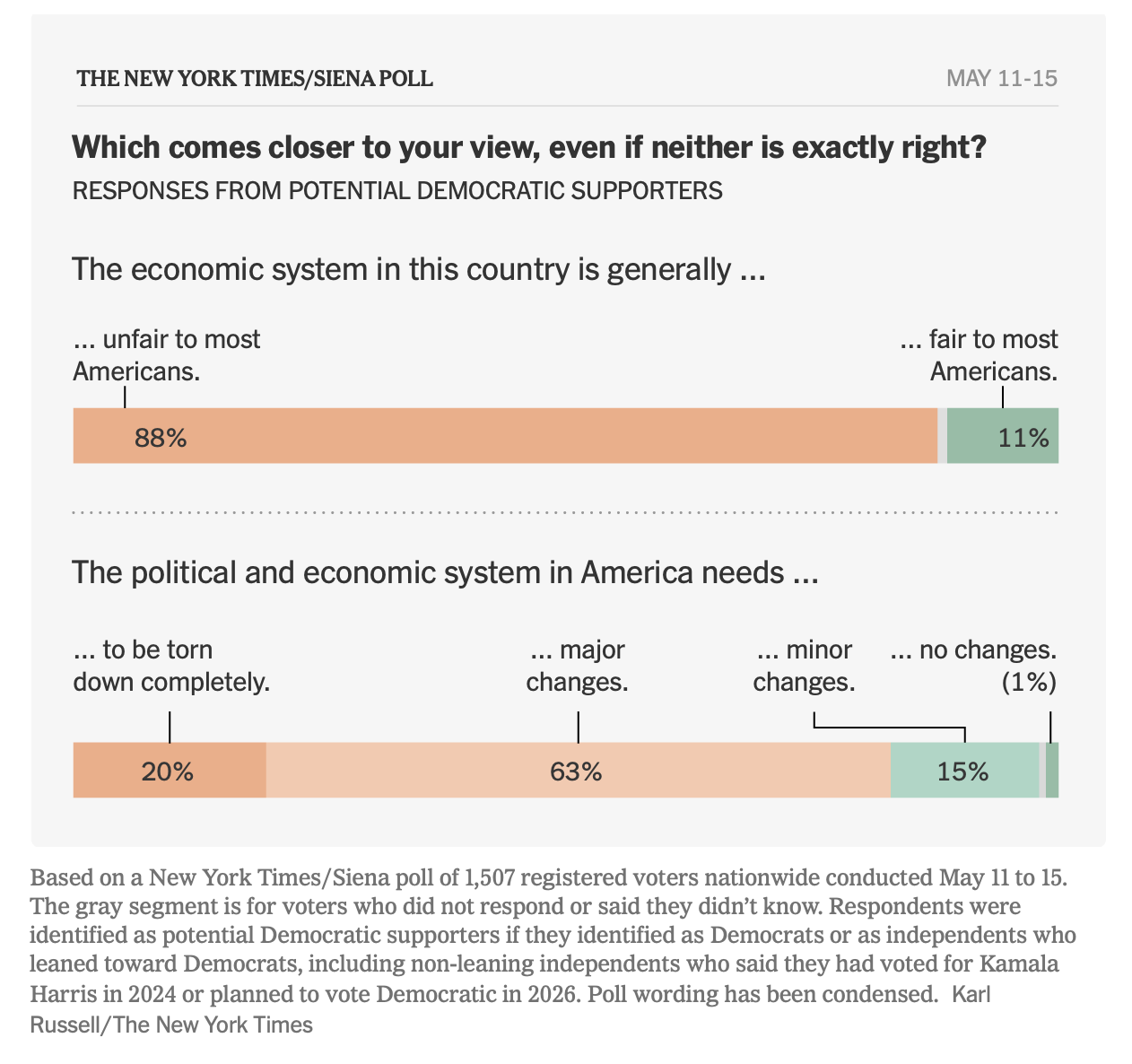
We should not expect economic anxiety to simply fall away. A new New York Times/Siena poll fielded May 11–15 finds that 88% of potential Democratic supporters say the American economic system is unfair to most Americans, and 83% say the political and economic system needs major changes (63%) or to be torn down completely (20%). Only 1% want no changes at all.
The only way to escape the gravity of anti-incumbent sentiment is to do something big enough that voters actually feel it, or signal that you’re trying. You don’t need a 12-point plan and to rattle off macroeconomic indicators from the Oval Office; Biden tried that. The next Democratic candidate will need something on the scale of the New Deal or the Great Society — a generational project that reorders the relationship between the American economy and the American worker, and that voters can point to and say “My life is better because of this party.”
Democrats need a president who, in 2029 — like Zohran Mamdani in New York City — says the cost of housing, healthcare, childcare, and energy is the central political question of our time, and who proposes to do something on the scale of that problem. There are lots of options on the table for a party that wants to go big. Build millions of new homes. Cap the price of insulin and expand negotiation to every essential drug. Subsidize childcare or make it a public good. Build out clean energy infrastructure fast enough to combat rising costs from AI infrastructure and climate change. Tax the people who have captured most of the economic gains over the last 20 years and use the money to fund the policies ordinary people actually buy. Pick fights with the industries that profit from scarcity and dysfunction — and win them.
This, of course, will be hard; defying gravity always is. It requires governing the way Roosevelt and Johnson governed, with the assumption that bold action creates its own political coalition. And it also requires you to look back on your failures with a holistic view of what causes certain outcomes.
I have not yet seen anything close to this from the party, from the think tanks, or from the leading 2028 contenders. There are gestures toward the “abundance” agenda, populism, and “radical centrism,” but these mostly read like positioning exercises, not serious agendas for a people that are really hurting. The 2024 autopsy was a chance to start that conversation by being honest about why Harris lost. It failed to do that.
This matters because the fundamentals giveth and the fundamentals taketh away. A Democratic win in 2028 built on Trump backlash, without a generational economic vision behind it, is a Democratic loss in 2032 waiting to happen. The only durable answer to anti-incumbent sentiment is to actually earn re-election. The party has roughly two and a half years to decide whether it wants to think that big — and that creatively.
Next week’s Chart of the Week will dig into a new Strength In Numbers survey with a lot of new data on how voters are actually thinking about the economy right now — what they blame for high prices, who they trust to fix it, and how the two parties’ economic brands have shifted since Trump took office. (Subscribe if you haven’t already!)
I would have liked to see a DNC autopsy with more data, more research, and more attention to the real hard work on voter psychology, economic anxiety, and the path forward. The 2024 autopsy was the party’s chance to confront the thing it actually got wrong. Harris lost because prices were high, Biden was unpopular, and voters across the world were in a mood to punish whoever was in charge. It is surprising to read a hundred pages about messaging discipline and rural organizing and still miss that fundamental fact. And yet.
Democrats are about to be handed a win in 2026–28 by voters who are angry at the party currently in power. If they mistake that for vindication of a new strategy that fiddles around the margins — instead of the same structural anti-incumbency that buried Harris — they will spend the 2030s out of power and wishing they had thought bigger when time was still on their side.
If you got something out of this piece, consider a paid subscription to help fund future articles like this one.
What this partly overlooks is the fact that no matter how favorable the results of the 2026 and 2028 elections turn out to be for Democrats, the Republicans will still have their twin “firewalls” behind which they can retreat—SCOTUS and the rules that govern the operation of the US Senate (de facto 60 vote requirement to pass non-reconciliation bills and the filibuster). As long as those remain in place, what we will be likely to get from the next Democratic administration will be attempts to address the real problems Elliott raises in this excellent essay that will be blocked at every turn. The Republicans will then be able to use the very real anti-incumbency tailwind Elliott describes in 2032 to swing back into power and complete their destruction of American democracy.
If Elliott is right (and I believe he is), the Democrats will have roughly 12-18 months post 2029 Inauguration to put some points on the proverbial board in terms of creating some tangible benefits for typical Americans. However, without addressing the GOP firewalls, it is highly unlikely that they will be able to so. That leaves open the question of how to change the basic parameters of the situation quickly enough to give the presumptive new Democratic administration operating room to legislate on behalf of voters. I still have not heard anyone offer a credible explanation on how to make this come to pass.





What this partly overlooks is the fact that no matter how favorable the results of the 2026 and 2028 elections turn out to be for Democrats, the Republicans will still have their twin “firewalls” behind which they can retreat—SCOTUS and the rules that govern the operation of the US Senate (de facto 60 vote requirement to pass non-reconciliation bills and the filibuster). As long as those remain in place, what we will be likely to get from the next Democratic administration will be attempts to address the real problems Elliott raises in this excellent essay that will be blocked at every turn. The Republicans will then be able to use the very real anti-incumbency tailwind Elliott describes in 2032 to swing back into power and complete their destruction of American democracy.
If Elliott is right (and I believe he is), the Democrats will have roughly 12-18 months post 2029 Inauguration to put some points on the proverbial board in terms of creating some tangible benefits for typical Americans. However, without addressing the GOP firewalls, it is highly unlikely that they will be able to so. That leaves open the question of how to change the basic parameters of the situation quickly enough to give the presumptive new Democratic administration operating room to legislate on behalf of voters. I still have not heard anyone offer a credible explanation on how to make this come to pass.
Outstanding analysis!!! I hope every one of influence in the Democratic Party reads this and acts on your excellent advice!